

A matching footprint and capacitance can still hide a costly mismatch. Effective capacitance under DC bias, dielectric behavior, tolerance, and temperature characteristics all affect whether an alternate will perform as intended. That’s why high capacitance MLCC drop in replacement sourcing should start with electrical evidence, not a part-number resemblance.
When an original MLCC is difficult to source at the required volume, a similar-looking alternative can seem like the fastest route forward. But availability alone doesn’t establish interchangeability. A disciplined review helps engineering and procurement assess technical fit and sourcing integrity before an alternate enters production.
This guide explains how to define electrical and mechanical acceptance criteria, compare candidate datasheets, and assess effective capacitance at the circuit’s operating voltage. It also covers sample testing in the application, verified procurement, and the information to include in an RFQ or BOM review. Adage Components supports pin-for-pin replacement evaluation with a spec sheet and/or samples for engineering review. These inputs support, but do not replace, your qualification process.
Key Takeaways
- Use a comparison table to document each candidate’s electrical and mechanical values, evidence source, and review status.
- Choose deliberately between sourcing the exact MPN, evaluating an approved alternate, and assessing a pin-for-pin candidate.
- Compare datasheets against application requirements before purchasing or substituting a part in production.
- Effective high capacitance MLCC drop in replacement sourcing depends on technical fit and verified procurement, not footprint or availability alone.
- Adage Components supports sourcing reviews with direct verified procurement, worldwide in-person manufacturing audits, and pin-for-pin replacement information for engineering evaluation. The company brings 30+ Years Experience.
Why High-Capacitance MLCC Replacement Sourcing Needs More Than an Available Part
Finding a source for an exact manufacturer part number answers an availability question. It doesn’t establish that a different part will perform acceptably in the circuit. High-capacitance MLCCs can be small, but their role in filtering, decoupling, or other circuit functions can make them consequential BOM items. A change that appears minor in procurement may affect electrical performance or require design review.
A replacement isn’t qualified by capacitance and package alone. High capacitance MLCC drop in replacement sourcing requires evidence that the candidate meets the application’s electrical and mechanical requirements, not just that it can be purchased or placed on the same pads.
What makes a high-capacitance MLCC replacement difficult?
Start by comparing capacitance, rated voltage, dielectric, tolerance, and package. These values describe different aspects of the part, and a close match in one does not compensate for a mismatch in another. The Ceramic capacitor overview provides background on MLCC construction and use. Candidate selection, however, depends on the manufacturer’s datasheet and the circuit’s requirements.
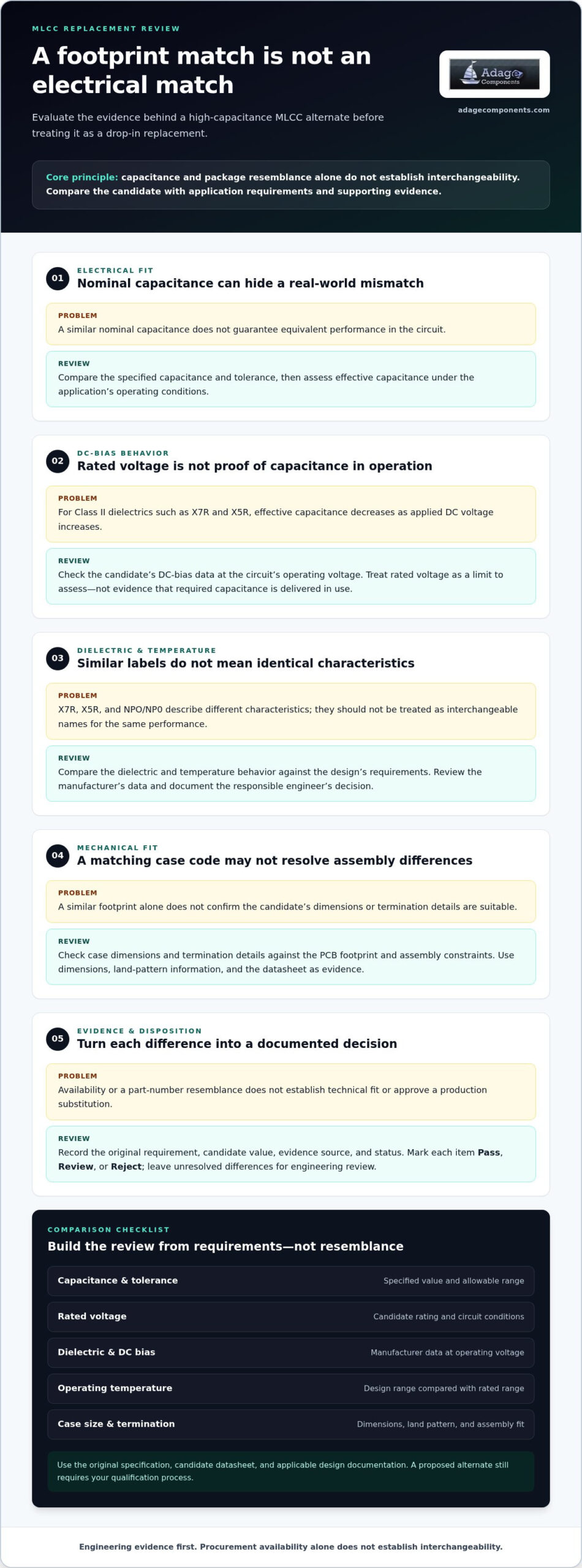
Nominal ratings don’t tell the whole story. For Class II dielectrics such as X7R and X5R, effective capacitance decreases as applied DC voltage increases. Compare the candidate’s DC-bias data at the circuit’s operating voltage, alongside its temperature behavior and tolerance. Rated voltage is a limit to assess, not proof that the capacitor delivers the required capacitance in operation. A similar footprint confirms neither these electrical characteristics nor equivalence.
How supply exposure becomes a design and procurement issue
If a BOM depends on one exact part number and has no approved alternate, a supply constraint can become a schedule issue. Procurement may identify a candidate, but engineering still needs to compare its documentation with design requirements and decide whether further evaluation is needed. The issue is not only whether a component can be sourced, but also whether a technically supported change can be reviewed and controlled in time.
Consider alternates before a shortage becomes urgent. Engineering can define acceptable limits, identify the evidence needed for review, and establish a disposition process while the original component is still available. This supports sourcing resilience without treating a proposed alternate as automatically approved. For a broader view of sourcing across passive components, use a related passive-component sourcing guide to structure BOM review beyond this MLCC decision.
Which Electrical and Mechanical Parameters Define an MLCC Drop-In Replacement?
Use a side-by-side comparison to turn a proposed alternate into a documented engineering decision. Record the original requirement, the candidate’s stated value, the evidence supporting that value, and its review status. Populate the table from the original specification, candidate datasheet, and applicable design documentation. Mark unresolved differences for review rather than assuming they are acceptable.
| Parameter | Original-part requirement | Candidate value | Evidence source | Review status |
|---|---|---|---|---|
| Capacitance and tolerance | Enter specified value and allowable range | Enter nominal value and tolerance | Datasheet, design requirement | Pass, review, or reject |
| Rated voltage | Enter required rating and circuit conditions | Enter candidate rating | Datasheet, application review | Pass, review, or reject |
| Dielectric | Enter specified dielectric | Enter candidate dielectric | Manufacturer datasheet | Pass, review, or reject |
| Case size and termination | Record footprint and assembly constraints | Record package and termination details | Dimensions, land pattern, datasheet | Pass, review, or reject |
| Operating temperature | Enter design temperature range | Enter rated operating range | Datasheet, environmental requirements | Pass, review, or reject |
Compare capacitance, voltage, and dielectric behavior
Nominal capacitance is a label, not a guarantee of equivalent in-circuit performance. Compare the specified capacitance and tolerance, then assess effective capacitance under actual operating conditions. For Class II dielectrics, review the candidate’s DC-bias curve at the circuit voltage. Use manufacturer data rather than inferring behavior from the nominal value or a higher voltage rating.
Dielectric designations also matter. X7R, X5R, and NPO/NP0 describe different characteristics, so don’t treat them as interchangeable names for the same performance. A change in dielectric may be acceptable only if the responsible engineer determines that the candidate meets circuit requirements across relevant conditions. Record the decision and its supporting evidence.
Check package, temperature range, and qualification requirements
Confirm case dimensions and termination details against the PCB footprint and assembly constraints. A matching case code alone may not resolve differences that matter to placement or soldering. Compare the candidate’s operating-temperature specification with the design’s environmental requirements, including any limits that are mandatory for the end application.
Separate hard design limits from parameters that can be reviewed. Required voltage, footprint compatibility, or a defined temperature range may be acceptance gates. Other differences need an explicit engineering assessment, not an informal assumption. For automotive or other regulated use, review documentation for the exact component and required qualification. A supplier-level statement isn’t a substitute for part-specific evidence.
For high capacitance MLCC drop in replacement sourcing, this record gives procurement and engineering a shared basis for screening candidates. Adage Components’ MLCC product line information can help focus the component search; technical acceptance still depends on the application review.
How Should Engineers Compare an Exact MLCC, an Alternate, and a Pin-for-Pin Replacement?
These are three distinct sourcing routes, not levels of automatic approval. The exact manufacturer part number (MPN) preserves the specified component, an approved alternate uses a candidate already accepted under the design’s controls, and a pin-for-pin candidate offers a possible physical match for engineering evaluation. Compare the routes by design-change effort, supporting documentation, sourcing flexibility, and qualification ownership before selecting one.
- Source the exact MPN: This preserves the specified component and usually avoids evaluating a different part. It involves the least design-change effort when the exact manufacturer and ordering code are available, but keeps sourcing tied to that part number.
- Use an approved alternate: This can add sourcing flexibility if the alternate is documented and approved for the relevant design and use. Confirm the approval scope and supporting records. An alternate accepted for one application or revision may not apply to another.
- Assess a pin-for-pin candidate: This approach can identify a component intended to align with the original’s connection and placement arrangement. It can start a comparison, but engineering still needs to evaluate application fit and determine the qualification steps.
When an exact manufacturer part number remains the right choice
Prioritize the exact MPN when the design documentation or qualification requirements call for that specific component. Check the manufacturer name, complete ordering code and suffix, package, and applicable document revision. Small differences in an ordering code can identify a different variant, so don’t rely on a shortened BOM description alone. If the exact part creates sole-source exposure, document that constraint and define how a potential alternate would be reviewed, without treating it as approved in advance.
What pin-for-pin replacement does, and does not, establish
“Pin-for-pin” describes a replacement approach, not a conclusion that the circuit can use the candidate without review. It indicates that a proposed part is being matched with the original in a way that considers placement and connections. The customer’s design requirements, application conditions, and qualification controls determine acceptance. A spec sheet and/or sample can support comparison and evaluation, but neither is approval by itself.
Keep responsibilities explicit. Procurement can identify the sourcing route, provide complete part identifiers, and preserve source and traceability records. Engineering determines whether a candidate satisfies design requirements and what validation is needed. Quality or program controls may also define the records required before a BOM change is released. This separation prevents sourcing urgency from being mistaken for technical disposition.
For high capacitance MLCC drop in replacement sourcing, record the selected route and decision owner alongside the candidate documentation. This creates a clear path from sourcing inquiry to engineering disposition, while preserving the option to pursue an alternate when the exact MPN is constrained.
A Practical Workflow for Qualifying a High-Capacitance MLCC Alternate
A controlled workflow connects candidate selection, technical review, and sourcing records. It also prevents availability from driving an unreviewed BOM change. Compare every alternate with the original specification and retain a record of the decision.
Prepare the BOM and replacement requirements
Start with accurate source data. A complete BOM or RFQ gives reviewers the context to identify the original component and assess candidate information. Adage Components’ BOM submission form provides a structured way to share component details for review.
- Collect the original data. Record the manufacturer, full MPN including suffix, required quantity, package, and any alternates already approved for the specific design. Note the BOM revision so the evaluation is tied to the correct configuration.
- Define application requirements. Gather the relevant electrical, environmental, and use conditions from the design documentation. Include operating voltage and temperature where applicable, and identify any qualification or traceability requirements that govern the component.
- Separate acceptance gates from review items. Mark non-negotiable limits clearly, such as a required package or specified operating range. Identify other differences that the responsible engineer may assess. This helps screen candidates without treating every deviation as either acceptable or disqualifying by default.
- Identify candidate parts and obtain current documentation. Match the candidate to the intended application, then gather its manufacturer datasheet and supporting component information. Confirm the data applies to the exact candidate MPN, not just a product family.
- Compare documentation before purchase or substitution. Review the candidate datasheet against the original requirements and application conditions. Record matching values, differences, missing evidence, and questions for engineering. Do not purchase for production substitution until the review establishes the next required disposition.
- Evaluate samples and document the decision. Where the design process calls for sample validation, evaluate samples through the customer’s established procedure. Capture test results, decision owner, approval status, and any restrictions. Update the approved BOM and retain supporting records before releasing a production change.
Review documentation, samples, and approval records
A datasheet comparison is a screening tool, not a substitute for application-level validation when the design process requires testing. Keep the record useful to engineering and procurement: identify the document revision, candidate MPN, comparison outcome, and unresolved items. If sample evaluation is required, tie the results to the candidate and requirements used in the datasheet review.
Close the loop with a clear disposition: approved for the defined use, rejected, or awaiting further review. Add any design restrictions or conditions to the BOM record so the decision isn’t mistaken for blanket approval across other products or revisions. This disciplined approach supports high capacitance MLCC drop in replacement sourcing while maintaining design control.
To support candidate identification alongside your review process, review Adage Components’ MLCC product line.
How Adage Components Supports Verified High-Capacitance MLCC Sourcing
Adage Components is an international electronic component representative firm with 30+ Years Experience. We help OEMs and electronic manufacturers connect sourcing requirements with component options, technical information, and international logistics. Our focus is authentic components through direct verified procurement channels, with manufacturer pricing and OEM pricing for customers seeking cost-effective supply.
Verified procurement and manufacturing oversight
We use direct verified procurement channels and work with vetted manufacturers and partner suppliers, many of which are franchised by top 100 distributors. Worldwide in-person manufacturing audits form part of our sourcing approach. These measures support supply-chain integrity, alongside the component documentation and quality controls required for each customer’s review.
We support sourcing for commercial and automotive grade components, offering high-capacitance MLCCs and SMD ceramic capacitors with confirmed dielectric options including NPO, X6S, X7R, X5R, and Y5V. Use the design criteria in your request to focus candidate evaluation; a dielectric option alone does not establish suitability for a circuit.
Our pin-for-pin replacement support can include a spec sheet and/or samples as inputs to engineering review. A proposed match is not automatic circuit approval. Your design requirements and qualification process determine whether a candidate is accepted.
Prepare a focused MLCC sourcing request
Send the full BOM or RFQ with original manufacturer part numbers, quantities, and target requirements. Include relevant application conditions and identify which requirements are mandatory. This gives us the information to focus the sourcing review and identify relevant component details. You can share structured part data through the BOM submission form.
Our international logistics program and global stocking capabilities support supply planning and MRP integration. We work to coordinate delivery to your facility and support shorter lead times, while keeping sourcing details aligned with your requirements.
To assess component options for your BOM, review the Adage Components line card. We can help connect your sourcing request with relevant product information and replacement inputs for your engineering team’s documented disposition.
Make Alternate Readiness Part of Your BOM Process
Build replacement readiness into routine BOM maintenance, not only urgent sourcing decisions. Assign ownership for reviewing candidate parts, recording engineering dispositions, and keeping approved BOM data current. This gives procurement a defined path to act when the specified MPN becomes difficult to obtain, while keeping technical acceptance with the responsible engineering team.
For your next high capacitance MLCC drop in replacement sourcing review, start with the parts that carry the greatest production impact. Bring together the complete MPN, application requirements, target quantities, and any documented alternate criteria. A focused request helps align the sourcing search with the design’s actual needs and preserve clear decision records.
Adage Components supports your evaluation with component information and pin-for-pin replacement inputs for engineering review. Review the component line card to identify relevant options for your sourcing requirements.
Frequently Asked Questions
Can a higher-capacitance MLCC replace a lower-capacitance part in the same circuit?
Not automatically. A larger nominal capacitance can change circuit behavior, including filtering, transient response, or interactions with other components. The effect depends on the circuit function and operating conditions, so the engineer should assess the design rather than assume that more capacitance is harmless. For example, check whether the capacitor is part of a timing or frequency-sensitive network before approving a higher-value candidate.
Does a matching MLCC footprint mean the replacement is electrically interchangeable?
No. A matching footprint only indicates that the component may fit the same board area; it doesn’t establish equivalent circuit performance. The candidate could differ in effective capacitance, dielectric behavior, or other electrical properties that matter to the design. Treat footprint compatibility as a mechanical screening result. Engineering still needs to assess the candidate against the circuit function and confirm that the proposed change fits the board’s design controls.
How does DC-bias voltage affect the effective capacitance of an MLCC?
For many Class II MLCCs, applying DC voltage reduces effective capacitance from its nominal value. The amount varies by component and operating conditions, so use the manufacturer’s DC-bias curve rather than estimating from the printed capacitance or rated voltage. Compare the expected capacitance across the circuit’s operating voltage range with the design’s minimum requirement. A candidate that appears suitable at zero bias may provide less capacitance in use.
What does the X7R dielectric designation tell an engineer about an MLCC?
X7R identifies a Class II ceramic dielectric with defined temperature-related capacitance behavior. It helps engineers classify the component, but the designation alone doesn’t show the candidate’s effective capacitance under applied DC voltage or establish suitability for a particular circuit. Review the specific manufacturer datasheet for the component’s temperature characteristics and DC-bias information. Don’t assume two X7R parts have identical performance just because they share the same dielectric code.
Can one high-capacitance MLCC replace two capacitors in a design?
Only after reviewing the circuit and board-level consequences. Two capacitors may serve separate locations or functions, even if their nominal capacitances add up to the value of one candidate. Combining them can change placement, current paths, and the circuit’s response to transient conditions. The engineer should assess the schematic, layout, operating requirements, and validation needs before approving a component-count change or updating the BOM.
What documentation should accompany an MLCC replacement candidate?
Provide the full candidate MPN and current manufacturer datasheet, including relevant capacitance, voltage, temperature, and DC-bias information. Add package or land-pattern details where board fit is part of the review. For high capacitance MLCC drop in replacement sourcing, include the original part identifier, application requirements, and any sample evaluation results or quality records required by your process. Keep the final engineering disposition linked to the reviewed candidate.
How should an OEM handle an MLCC part that is discontinued by its manufacturer?
First, document the discontinuation notice and identify affected BOMs, production plans, and service needs. Then assess remaining supply requirements and start an engineering review of candidate alternates before updating production records. Compare each candidate with the original design requirements, and follow your organization’s validation and change-control process. Keep the selected MPN, supporting documentation, and approval scope traceable so the alternate isn’t applied to other designs without review.
Disclaimer
Cross-referenced components needs to be confirmed by the client with either spec. sheet or samples or both.
Please note, we use AI to help us, information is verified to be correct but we can not guarantee 100% accuracy.