

What if a capacitor that looks like a direct replacement creates a mismatch in your design or interrupts production? Effective capacitor sourcing starts with specification control and verified procurement, not just a stock listing. A hard-to-source part or unverified supply can raise authenticity concerns and disrupt your BOM, MRP workflow, and production schedule.
Those risks are real for OEM and EMS procurement teams. You need components that match electrical and mechanical requirements, come through trusted channels, and support supply continuity without weakening quality controls. We source authentic capacitors through direct verified procurement channels, working with vetted manufacturers and partner suppliers. Our range includes MLCC, tantalum, aluminum electrolytic, film, and safety capacitors for commercial and automotive applications.
This guide explains how to specify capacitor requirements against your BOM, verify component authenticity, and assess pin-for-pin replacements using spec sheets and/or samples. You’ll also learn how international logistics and stocking programs can support MRP planning, while cost and lead-time decisions stay grounded in fit and quality. Adage Components brings manufacturer pricing and international sourcing support to your procurement process.
Key Takeaways
- Build a complete capacitor requirement from electrical ratings, package and termination details, and application constraints before requesting quotes.
- Use specification control to distinguish catalog purchases, replacement assessments, and OEM procurement routes.
- Structure capacitor sourcing around clear handoffs between engineering, procurement, and quality, from BOM preparation through replenishment planning.
- Assess alternatives through documented, pin-for-pin comparisons supported by specification sheets and/or samples.
- Use direct verified procurement, worldwide manufacturing audits, and technical support to strengthen sourcing decisions.
Capacitor Sourcing for OEMs: Why Component Fit Is Only the Starting Point
A capacitor can match a line on a bill of materials and still fail to meet the needs of a production program. Whether producing commercial circuit boards or industrial power equipment—such as the medium-voltage systems built by Africa Switchgear & Transformers—OEM procurement must align technical requirements with component authenticity, purchasing controls, and delivery planning. Selecting a suitable part addresses the design; securing a dependable supply requires a broader process that keeps engineering, procurement, and replenishment aligned.
What capacitor sourcing means in an OEM supply chain
Capacitor sourcing is specification-led procurement that verifies a component against design and application requirements, then coordinates its supply for production and replenishment. It goes beyond locating a listed part. The process connects the approved component to an accurate BOM, a controlled procurement route, and a supply plan that supports production.
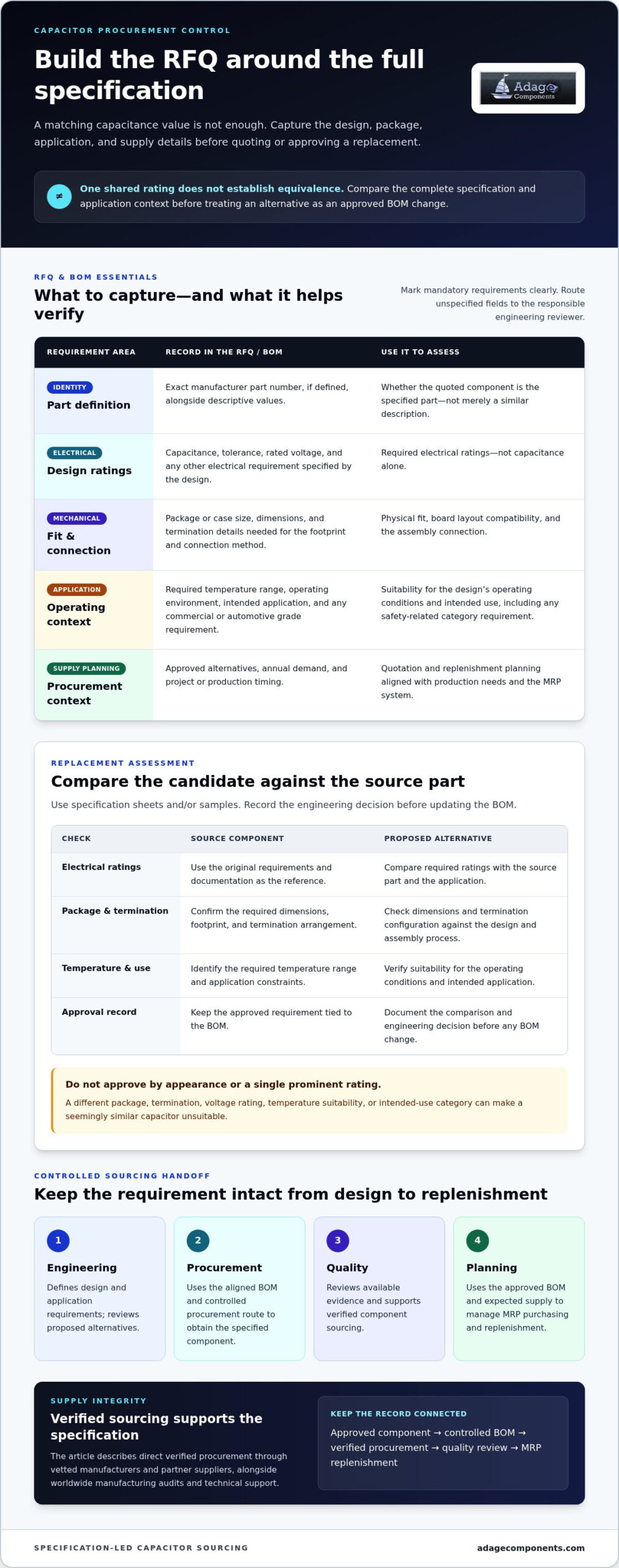
A disciplined sourcing record helps teams distinguish the required component from a part that merely shares a familiar description. Engineering defines what the design needs. Procurement uses that information to obtain the right component through verified channels. Quality reviews the available evidence, while planning uses the approved BOM and expected supply to manage purchasing and replenishment in the MRP system. A clear record reduces ambiguity when a part becomes difficult to obtain or a replacement is considered.
This section focuses on sourcing decisions, not capacitor theory. For a concise overview of types and operating principles, see Understanding Capacitor Fundamentals. Understanding what capacitors do helps frame the design; sourcing ensures the selected component can be procured and maintained as part of a controlled production supply.
Why replacement sourcing needs disciplined specification control
A similar capacitance value alone doesn’t establish equivalence. Two capacitors can share that value yet differ in voltage rating, temperature suitability, package dimensions, termination style, or intended application. Those differences can affect electrical performance, physical installation, or compatibility with circuit operating conditions.
For example, a candidate replacement may fit the same general circuit role but have a different package or termination arrangement that conflicts with the board layout or assembly process. A voltage or temperature mismatch can also make a part unsuitable for the design’s operating conditions. In safety-related applications, the component’s intended use and required category matter too. Resolve these checks before treating a substitution as an approved BOM change.
The practical lesson is simple: identifying a part by appearance or one prominent rating can narrow the search, but it cannot complete qualification. Compare the full specification and application context. When considering a pin-for-pin alternative, assess it against the original requirements using specification sheets and/or samples, and record the engineering decision before updating the BOM. That control helps prevent an unreviewed substitution from flowing into purchasing or MRP planning.
Match Capacitors to BOM and Verify Component Quality
A useful RFQ gives suppliers enough detail to identify the required capacitor without guessing. Keep the BOM and sourcing request aligned: incomplete fields can lead to quotations for parts that look similar on paper but don’t meet design, footprint, or production requirements. Separate confirmed design requirements from preferred options so reviewers can assess any proposed alternative against the right criteria.
Which capacitor details should an RFQ or BOM include?
Start with the exact manufacturer part number, if defined, then record the design and application details needed to evaluate a match. Mark any field that engineering considers mandatory, and identify where alternatives may be reviewed.
- Electrical: capacitance, tolerance, rated voltage, and any other electrical requirement specified by the design.
- Mechanical: package or case size, dimensions, and termination details needed to match the footprint and connection method.
- Environmental and application: required temperature range, operating environment, and intended application, including any commercial or automotive grade requirement.
- Procurement context: approved alternatives, annual demand, and project or production timing to support quotation and replenishment planning.
Include the manufacturer part number alongside descriptive values whenever possible. Capacitance alone doesn’t uniquely identify the required part. If a field is not specified, don’t silently assume it is flexible; route the question to the responsible engineering reviewer before approving a substitute.
How to assess a pin-for-pin replacement
Matching one capacitor rating alone does not establish equivalence. A proposed alternative needs a documented comparison against the source part and the application, not just a matching capacitance value or similar appearance.
Compare the candidate’s specification sheet with the source part’s documentation. Review required electrical ratings, package dimensions, termination configuration, temperature range, and application constraints. Then check that the candidate’s footprint and physical fit align with the design. A part can be pin-for-pin in layout and still differ in another requirement that matters to the circuit or operating environment.
Use specification sheets and/or samples to support a controlled evaluation. Engineering should determine whether the candidate meets design requirements; quality and procurement should retain the supporting documents and approval record. Change the BOM or approved-alternative list only after the required review. This gives purchasing a clear basis for ordering and helps prevent an unreviewed substitution from entering production.
For quality decisions that involve measurement, distinguish component qualification from measurement traceability. The NIST capacitance calibration reference describes calibration services and standards; it does not approve a particular capacitor for an application. In capacitor sourcing, use supplier documentation and engineering review to establish part suitability, and treat measurement evidence according to the specific verification need.
Once requirements and approval criteria are clear, compare relevant capacitor categories on the Adage Components capacitor line card as part of preparing a focused sourcing request.
Capacitor Sourcing Routes: Compare Catalog Buying, Replacement, and OEM Procurement
The right purchasing route depends on whether you need an approved part, a qualified substitute, or a coordinated supply plan for production. Catalog buying can serve a clearly defined requirement. Replacement assessment adds technical review. OEM procurement connects component requirements with BOM quantities, order context, and replenishment planning. Compare routes by the controls your program needs, not convenience alone.
| Route | Specification control | Documentation | Order context | Supply coordination |
|---|---|---|---|---|
| Catalog buying | Works best with the exact approved part number | Listing and available part documentation | Often a defined, discrete requirement | Usually focused on the individual order |
| Replacement assessment | Requires comparison with the source part and application | Candidate specifications and evaluation records | Used when an alternative is being considered | Follows technical review and approval |
| OEM procurement | Anchored to BOM and production requirements | Records aligned with the component and program | Supports OEM or EMS demand across production needs | Can connect sourcing, logistics, and replenishment |
When catalog purchasing fits a defined requirement
A catalog route can suit buyers who have the exact approved manufacturer part number and need a clearly defined order. It offers a direct reference for purchasing an established BOM item. But a listing alone doesn’t prove that the part suits the application or establish its provenance. Keep the approved part number and supporting documentation tied to the BOM record, and apply the relevant verification controls before placing the order.
Standards can inform quality practices, but a standards organization’s broad role is not approval of a specific component. The IEEE Standards Association develops standards across technical fields; component qualification remains tied to the requirements and evidence relevant to the design.
When OEM sourcing support fits a production requirement
OEM or EMS programs with BOM-level demand may need coordination beyond a single listing. Procurement can account for required quantities, project timing, and planned replenishment as part of the sourcing decision. Adage Components works with vetted manufacturers and partner suppliers, many of which are franchised by top 100 distributors, to support these requirements.
Evaluate cost alongside fit and authenticity controls. Adage Components offers manufacturer pricing and OEM pricing, with the same advantages as buying from tier 1 distributors but at OEM pricing. Compare quotes against approved requirements and supporting documentation, not price alone. A structured BOM submission for component review can help establish production needs across the list.
A Practical Capacitor Sourcing Workflow for RFQs, Qualification, and MRP
A repeatable workflow gives engineering, procurement, and quality clear review points before a capacitor enters the production plan. It also links the RFQ to order and replenishment decisions, so supply planning doesn’t outrun technical approval. Use these steps to keep requirements, evidence, and timing connected.
Prepare a complete capacitor RFQ or BOM
Consolidate the information in one request rather than relying on scattered notes. Include the source part number, defined electrical and mechanical requirements, required quantities, and project or production timing. Identify approved alternatives and specify whether engineering review is required before a substitution can be purchased. A complete BOM submission gives the sourcing process a clear starting point.
- Engineering defines the requirement. Confirm the BOM part number and application constraints. Separate fixed design requirements from preferences, and identify any substitute that needs technical evaluation before approval.
- Procurement prepares the RFQ. Consolidate quantities, demand context, and timing with the technical information. Note whether the request covers a project build, ongoing production, or replenishment so responses can be assessed against the right order context.
- Quality reviews supplier evidence. Assess the procurement route and supporting documentation for the component. Supplier controls can include manufacturing audits and relevant quality records. Keep evidence associated with the part and supplier under review rather than treating a quotation or listing as proof of component authenticity.
- Engineering evaluates alternatives. If a replacement is proposed, compare its documentation with the approved requirement and application. Record the technical decision and approval status before procurement updates the BOM or places an order for the alternative.
- Procurement aligns the order with the plan. Review quoted availability and delivery information against project timing and production demand. Coordinate international logistics with the planned delivery destination, and keep order details consistent with the approved BOM.
- Planning establishes replenishment. Use confirmed order information and demand assumptions to support MRP planning. Update replenishment inputs when approved part choices, quantities, or production timing change, so purchasing decisions reflect the current plan rather than an obsolete BOM.
Build quality and delivery controls into procurement
Keep verification active alongside supply planning. Worldwide in-person manufacturing audits support supplier quality assurance, while technical documentation helps teams assess the component against the requirement. Procurement and quality should retain relevant records with the sourcing decision, and engineering should own approval of technical alternatives. This creates a traceable handoff without confusing delivery coordination with component qualification.
International logistics coordination and global stocking programs can be aligned with your MRP workflow and delivery needs. Our sourcing approach is designed to support shorter-than-average lead times, with order planning based on current availability and your production requirements rather than an assumed duration. This helps teams make practical plans without treating an estimate as a guarantee.
For capacitor categories that may fit your approved BOM, review the Adage Components capacitor line card as you prepare sourcing requirements.
How Adage Components Supports Verified Capacitor Sourcing
Adage Components is a Canada-based international electronic component representative firm supporting OEM and EMS procurement. We connect your BOM requirements with verified procurement, technical support, and logistics coordination. Our international logistics program helps align component planning with your facility and MRP system.
Adage’s approach to authentic components and supplier quality
We work with vetted manufacturers and partner suppliers, many of which are franchised by top 100 distributors. In-person manufacturing audits worldwide support supplier quality assurance, while direct verified procurement channels help maintain component authenticity. Our technical support helps procurement teams assess sourcing requirements and related documentation.
For a difficult-to-source part, we support pin-for-pin replacement assessments using specification sheets and/or samples. These provide a basis for comparison, not automatic approval. Design requirements guide engineering’s suitability decision before an alternative is adopted in the BOM.
Partner credentials apply to their respective organizations and product lines. For example, Adage’s diode OEM partner holds ISO 9001, IATF 16949, ISO 14001, and QC080000 certifications. Component-specific documentation remains important when assessing a capacitor requirement.
Move from capacitor requirements to an RFQ
Adage supports sourcing for multilayer ceramic capacitors (MLCC), tantalum, aluminum electrolytic, film, and safety capacitors. Include the relevant BOM requirements and project context in your inquiry to focus the sourcing discussion on the component category and production need.
Adage Components is 20% more economical. Compare costs alongside technical fit and procurement controls, keeping the component requirement central to the decision. Review Adage Components’ capacitor and component line card to identify categories relevant to your BOM and take the next step toward an RFQ.
Turn Your Next Capacitor Requirement Into a Controlled Sourcing Plan
Make your next BOM decision a starting point for stronger supply continuity. Adage Components brings 30+ Years Experience to OEM procurement, supported by direct verified procurement channels and in-person manufacturing audits worldwide. For replacement needs, pin-for-pin assessments use spec sheets and/or samples to support a considered evaluation.
Share a clear requirement and define the next step for your team, whether that means sourcing an approved part or assessing an alternative. A disciplined capacitor sourcing plan keeps technical decisions connected to procurement and production priorities.
Review the capacitor and component line card to identify relevant categories for your BOM, then submit your RFQ or BOM to Adage Components to move your next sourcing decision forward.
Frequently Asked Questions
What information should I include when sourcing capacitors for an OEM BOM?
Include the manufacturer part number, capacitance, tolerance, rated voltage, package, termination, and application requirements. Add quantities, project timing, and whether engineering-approved alternatives are acceptable. For a multi-line RFQ, identify which BOM items are production-critical and flag any that need engineering review before substitution. This lets procurement distinguish firm requirements from flexible options and helps prevent incomplete information from slowing quotation or planning.
How do I verify that sourced capacitors are authentic?
Use a documented procurement route connected to vetted manufacturers, and retain supplier and component records with the purchase. Check that part identification and supporting documentation align with the specified manufacturer part number and order. Adage Components uses direct verified procurement channels and conducts in-person manufacturing audits worldwide as supplier controls. These practices support authenticity review, while qualification should still follow the evidence and requirements for the specific component and application.
Can a capacitor be replaced with one that has the same capacitance?
Not on capacitance alone. A candidate also needs to meet the design’s electrical, physical, temperature, and application requirements. For example, a part may share the nominal capacitance yet differ in package or rated voltage, making it unsuitable for the intended circuit or footprint. Treat the candidate as an alternative for engineering evaluation, not an approved substitute, until the relevant design criteria have been assessed.
What does pin-for-pin capacitor replacement mean?
Pin-for-pin replacement describes a candidate intended to match the original component’s connection arrangement and footprint, so it can be assessed for the same board position. It doesn’t automatically mean the part is electrically or environmentally equivalent. Compare the candidate’s documentation with the original requirements, and use spec sheets and/or samples to support review. Engineering should approve the replacement before the BOM or purchasing record is changed.
How do capacitor suppliers support OEM and EMS production planning?
Sourcing partners can connect component requirements and order context with procurement and delivery planning. For example, an EMS team supporting a scheduled build can share BOM demand and project timing so purchasing and logistics coordination reflect the production plan. International logistics and global stocking programs can also support MRP workflows. Keep forecast assumptions and approved part numbers current so replenishment decisions use the latest production information.
Which capacitor types can Adage Components source?
Adage Components supports sourcing for multilayer ceramic capacitors (MLCC), tantalum capacitors, aluminum electrolytic capacitors, film capacitors, and safety capacitors. The right category depends on the BOM and the component requirements defined for the application. Include the specified type and manufacturer part number in your RFQ when available, so the sourcing request stays aligned with the design and procurement can assess the correct component category.
What partner certifications are relevant when sourcing capacitors?
Certification relevance depends on the supplier and product scope. Adage’s diode OEM partner holds ISO 9001, IATF 16949, ISO 14001, and QC080000 certifications. These are partner credentials, not blanket certifications for every capacitor source. Review documentation for the specific supplier and component category, and confirm that the evidence supports the intended application rather than assuming one credential applies across all parts.
Disclaimer
Cross-referenced components needs to be confirmed by the client with either spec. sheet or samples or both.
Please note, we use AI to help us, information is verified to be correct but we can not guarantee 100% accuracy.