

A quoted delivery date may look firm while leaving your production plan exposed. To understand how to secure guaranteed delivery lead times from component vendors, treat the commitment as part of a broader procurement plan, not as a date in isolation.
Supplier lead time runs from purchase-order placement to receipt of the goods. Your end-to-end timeline may also depend on material availability, production schedules, and shipping, so a stated lead time may not cover every stage that affects inventory.
Forecasts and clear vendor terms matter, but timing matters too. Order too late and shortages can disrupt production; order too early or in excess and inventory can tie up working capital. A consistent lead time is easier to plan around than one that fluctuates, making visibility and performance tracking essential.
This article explains how to align demand forecasts, delivery commitments, and procurement timing to manage lead times, inventory, and cost. You’ll learn what to define in vendor terms, how to communicate changing requirements, and how lead-time variability affects reorder points and safety stock.
Key Takeaways
- Separate supplier delivery time from the full procurement timeline so production and receiving stages are included in planning.
- Share estimated annual usage and sales forecasts to help vendors plan component supply against expected demand.
- Put delivery schedules, change notifications and progress updates into clear vendor communications to reduce coordination gaps.
- Define late-delivery consequences and early-delivery incentives in vendor terms, with practical conditions for each.
- Use lead time and demand to set reorder points, then account for variability when determining safety stock.
1. End-to-end procurement lead time versus supplier delivery lead time
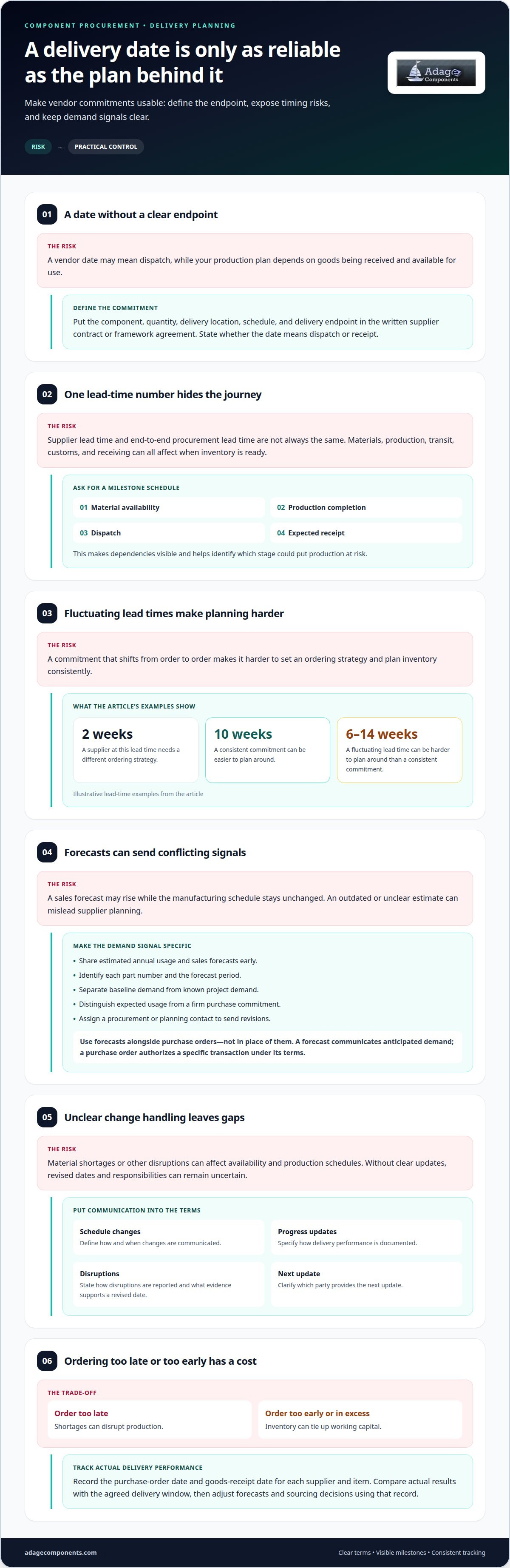
Supplier lead time usually measures the period from purchase-order placement to receipt of goods. End-to-end procurement lead time covers more: sourcing materials, supplier production, shipping, customs clearance, and your receiving process. A component can leave the factory on schedule yet arrive too late for production if transit or receiving adds delays. Before comparing vendor commitments, define the required endpoint, such as accepted goods being available for production.
Distinguish supplier lead time from manufacturing lead time in planning and contract language. Manufacturing lead time can include raw-material procurement, manufacturing, and shipping. Supplier lead time may describe only the supplier’s order-to-delivery window, depending on its definition. Ask for a schedule showing material availability, production completion, dispatch, and expected receipt. This makes dependencies visible and helps identify which stage could put production at risk.
For example, a supplier with a 2-week lead time needs a different ordering strategy from one with a 10-week lead time. A consistent 10-week commitment can be easier to plan around than a lead time fluctuating between 6 and 14 weeks. Track the purchase order date and goods receipt date for each supplier and item. Compare actual results with the agreed delivery window, then adjust forecasts and sourcing decisions using that record.
The practical answer to how to secure guaranteed delivery lead times from component vendors is to define the commitment in a written supplier contract or framework agreement. Specify the component, quantity, delivery location, schedule, and whether the date means dispatch or receipt. Set out how schedule changes will be communicated and delivery performance documented. For recurring demand, a framework agreement can establish standard terms, while individual releases specify quantities and dates. Releases still need to reflect capacity and material availability.
Capacity reservations and expedited-delivery agreements have no single standard cost. The cost depends on reserved capacity, reservation duration, component availability, shipment method, and agreed payment terms. Compare any added charge with the operational impact of delayed materials and the inventory cost of ordering earlier.
Delivery guarantees also involve defined exclusions and dependencies. Contracts may exclude penalties for force majeure events beyond the supplier’s control, while material shortages can affect availability and production schedules. Specify how disruptions are reported, what evidence supports a revised date, and which party provides the next update. Clear terms make exceptions visible instead of treating every delay as the same event.
For teams assessing how to secure guaranteed delivery lead times from component vendors, supplier rationalisation can simplify schedules by concentrating repeat demand with fewer qualified suppliers, while retaining alternatives for critical components. A framework agreement can document pricing terms, forecast sharing, and release procedures for recurring orders. Balance administrative efficiency against single-source exposure, especially when a component has no approved substitute or a missed delivery would stop production.
Estimated annual usage and sales forecasts
An estimated annual usage figure gives a supplier a planning signal beyond the next purchase order. It indicates the component demand a production plan may require across the year. Share the estimate early, especially for parts with long procurement or manufacturing stages. Advance visibility can help suppliers plan material availability and align the component pipeline with expected orders.
Build the forecast from historical usage, current sales forecasts, market trends, and other factors that affect demand. Then connect it to the internal production plan. For example, a sales forecast may rise while the manufacturing schedule remains unchanged. Resolve that difference before sending the estimate to avoid giving suppliers conflicting demand signals.
Make the estimate usable at component level. Identify each part number, specify the forecast period, and distinguish expected usage from a firm purchase commitment. Separate baseline demand from known project demand so suppliers can see which quantities support recurring production and which depend on a specific order. This detail improves sourcing discussions without presenting an estimate as a guaranteed release schedule.
- Review usage history: Use recorded component consumption to establish a baseline for each part number.
- Map demand to production: Connect projected usage with the production process and planned output.
- Flag demand changes: Explain whether a forecast change reflects sales, a project, or an internal schedule adjustment.
- Set update ownership: Assign a procurement or planning contact to send revised forecasts to suppliers.
Update the forecast when demand changes materially instead of letting an outdated estimate guide supplier planning. A revised production plan, for example, can affect the quantity and timing of component purchases. Sharing the change in advance gives the supplier an opportunity to review material requirements and production capacity before the next order. Clear revisions also help distinguish new demand from duplicate forecast entries.
Use forecasts alongside purchase orders, not in place of them. A forecast communicates anticipated demand; a purchase order authorizes a specific transaction under its terms. Align both records so the supplier can relate forecasted usage to actual releases. A component linecard can also help teams align forecasted parts with the component categories they source. This process supports reducing lead-time exposure by surfacing supply needs before production depends on them.
3. Communicating with vendors
Use one documented communication channel for each component order. Keep the purchase order, delivery schedule, and change notices tied to the same part number and revision. This gives procurement, production, and receiving teams a single current record. It also helps both parties distinguish a confirmed order from a planning update or proposed schedule change.
Agree on update points before production begins. Ask the supplier to report when materials are allocated, production starts, the order is ready to ship, and dispatch occurs. For a critical component, request immediate notice if material availability or capacity changes. Each notice should identify the affected order, revised timing, reason, and date of the next update.
Assess production capacity and delivery performance using capacity plans, production schedules, on-time delivery records, and lead-time adherence. For critical components, request supporting progress evidence such as sub-vendor purchase orders, raw-material delivery notes, or fabrication photos. Compare promised and actual delivery dates by component to spot recurring delays.
Structure each vendor update around specific operational details:
- Order status: Identify the purchase order, part number, quantity, and current production stage.
- Schedule variance: State the original delivery date, revised date, and cause of the change.
- Supply risk: Explain whether material availability, supplier capacity, or shipping affects the schedule.
- Next action: Name the owner and date for the next update or decision.
Regular progress reviews keep open orders visible. Review long-lead items, unresolved dependencies, and actions from the previous discussion. Record decisions and owners in shared notes. If a supplier reports a delay, ask which production stage is affected and whether the revised schedule changes other orders. This detail helps operations anticipate downstream effects instead of reacting after a shortage reaches the production line.
Clear metrics support productive vendor relationships when both parties use the same definitions. Track on-time delivery and lead-time adherence against agreed dates, then review exceptions with the supplier. Distinguish late dispatch from transit delays, since they call for different corrective actions. Consistent records also show whether an issue is isolated or recurring across purchase orders.
Keep communication active when requirements change. Send revised quantities or schedules promptly, identify superseded documents, and confirm which version governs the order. Miscommunication can cause order-entry errors, poor coordination, and production delays. A controlled update process protects the schedule and gives vendors a reliable basis for capacity planning.
4. Late-delivery penalties and early-delivery incentives
A delivery clause works only if both parties can identify a missed commitment. Define the required date, delivery location, component, and quantity in the purchase order or supplier agreement. State whether the deadline means dispatch, arrival, or completion of receiving inspection. These distinctions help procurement teams assess performance consistently and avoid disputes over different interpretations of “on time.”
Supplier contracts can establish penalties for late deliveries, excluding force majeure events beyond the supplier’s control. Specify the trigger, calculation method, documentation, and process for resolving a disputed delay. Tie the remedy to the operational impact, such as production interruption or emergency sourcing, rather than using a clause with unclear consequences.
How can buyers monitor vendor lead times and enforce service-level agreements? Record each promised date and actual receipt date against its purchase order, then review on-time delivery and lead-time adherence with the supplier. Follow the agreement’s process for documented exceptions, including applicable exclusions, and retain the correspondence and receiving records.
Before agreeing to an early-delivery incentive, define what “early” means and whether your receiving operation can accept the shipment. An early arrival may create storage or handling pressure if production cannot use the parts yet. Incentives can include more favorable payment terms or priority consideration for future contracts, rather than monetary rewards. Link the benefit to a delivery that improves operations without creating excess inventory.
Use a consistent review process to connect the agreement with actual procurement performance:
- Log the commitment: Capture the agreed date, quantity, delivery point, and relevant order terms.
- Confirm receipt: Record the arrival date and any receiving hold that affects component availability.
- Classify the variance: Separate supplier production delays from transit or receiving delays.
- Apply the terms: Document the event, assess exclusions, and follow the contract’s remedy process.
Review exceptions with the supplier before applying a penalty or incentive. For example, a shipment may arrive at the facility on schedule but remain unavailable to production during an inspection hold. Separating supplier performance from internal receiving time keeps the assessment accurate and makes corrective actions more relevant.
Before setting a remedy, calculate the operational impact of a late order. Consider whether the delay could cause stockouts, interrupt production, or require expedited procurement. Pair clear consequences with routine performance reviews, and revisit terms when recurring delays reveal a capacity or scheduling issue. This ties incentives to measurable delivery performance rather than vague expectations.
5. Lead-time effects on inventory and cost
Lead time determines how long demand must be covered by available inventory. A longer or less predictable supplier window can increase safety-stock needs, while excess stock ties up working capital and storage capacity. The goal is not simply to minimize inventory, but to align stock levels with demand, replenishment time, and the operational impact of a late component.
Start with the reorder point: average daily demand multiplied by lead time, plus safety stock. This calculation identifies when procurement should trigger replenishment. Use accurate demand and lead-time records for each component. A forecast that overlooks supplier variability can set the reorder point too low, increasing stockout risk, or too high, creating avoidable inventory.
Lead-time variability directly affects safety stock. Greater variability calls for more buffer inventory because replenishment is harder to predict. One safety-stock calculation uses a safety coefficient multiplied by lead-time standard deviation and daily demand. The formula shows the trade-off: higher demand or more variable replenishment increases the buffer needed to protect production.
Consider the effect of reducing an industrial supplies supplier’s lead time from ten days to five days. Safety stock can fall proportionally, freeing inventory while preserving the same planning logic. This change helps only if actual delivery performance reflects the shorter lead time. Recalculate the reorder point using observed supplier timing, not just a revised quotation.
Order size also affects total cost. Bulk purchases may reduce order frequency but increase inventory carrying costs and the risk of holding components beyond immediate production needs. Smaller, more frequent supplier orders can expedite shipments and improve inventory turnover. Compare both approaches using procurement costs, order processing, storage, and the operational impact of stockouts.
- Measure demand: Use component-level consumption and production requirements.
- Track variation: Compare planned lead times with actual receipts.
- Set the trigger: Apply the reorder-point formula to each critical part.
- Review order size: Balance carrying costs against replenishment frequency.
A supplier inventory arrangement can keep long-lead-time components on hand when needed while protecting the supplier from holding unpaid inventory. Define ownership, release timing, and the customer’s purchase commitment in the agreement. This can be a targeted solution for components with no approved substitute; it should not become a blanket commitment to stock every item.
For a practical sourcing review, map component requirements to available categories before adjusting reorder points. The strongest inventory decision combines demand accuracy, actual supplier performance, and a clear view of carrying costs.
Adage Components
Adage Components helps procurement teams align component sourcing with demand and cost priorities. We offer manufacturer pricing and OEM pricing, with the same advantages as buying from tier 1 distributors but at OEM pricing. Our goal is to deliver one of the best costs in the industry while sourcing authentic components through vetted manufacturers and partner suppliers, many franchised by top 100 distributors.
We support commercial and automotive grade components. Partner certifications include ISO 9001, IATF 16949, ISO 14001, and QC080000. Our international logistics program and growing state-of-the-art warehouse support short lead times and MRP system integration, helping coordinate delivery to your facility in real time, on time.
Contact Adage Components to discuss your component requirements.
Turn lead-time planning into a sourcing advantage
Turn your planning assumptions into a sourcing brief your team can use. Identify the components that pose the greatest production risk, then align their demand outlook, approved alternatives, and purchasing priorities. This gives procurement a clear basis for evaluating how to secure guaranteed delivery lead times from component vendors, without treating a quoted date as the only measure of supply reliability.
Adage Components supports component sourcing for requirements that include Thick Film Chip Resistors, Thin Film Precision Resistors, and Carbon Film Resistors. Share the part details and priorities that matter to your production plan so the sourcing discussion can focus on your operational needs.
Discuss your component requirements with Adage Components and take the next step toward a more controlled sourcing plan.
Frequently Asked Questions
What Does Lead Time Mean?
Lead time is the elapsed time between starting a process and reaching its defined endpoint. In component procurement, that endpoint might be supplier dispatch, arrival at your facility, or receipt after inspection. For example, an order can leave a supplier’s warehouse on schedule but remain unavailable to production while receiving checks are completed. Define the endpoint before using lead time in schedules, forecasts, or supplier comparisons.
Why is lead time management critical to your financial performance?
Lead-time management affects how much cash is committed to inventory and how exposed production is to shortages. A component ordered too early can occupy storage and working capital; one ordered too late can disrupt output or require costly recovery actions. For a practical review, identify parts that could stop production, then compare their actual replenishment patterns with demand and inventory policy. This focuses attention on items with the greatest operational and financial consequences.
What contract terms guarantee component vendor delivery lead times?
Contract terms can make delivery commitments measurable, but they should define the component, quantity, destination, delivery milestone, and schedule. Specify how changes are notified, how performance is recorded, and what remedy applies to a missed commitment. For example, a date based on shipment departure differs from one based on arrival at your receiving dock. Align the agreement with the point your production plan depends on, and state applicable exceptions clearly.
How do purchase orders define firm delivery dates and on-time delivery requirements?
A purchase order makes an order-specific date clear by tying it to the part number, quantity, ship-to location, and required delivery milestone. State whether the requested date means dispatch or arrival, and include receiving requirements that affect availability for production. If the schedule changes, issue a controlled revision that identifies the superseded date. This creates a clear record for order processing, receiving, and later performance review.
What penalties or remedies can buyers negotiate for late component deliveries?
Buyers can negotiate contract remedies such as agreed penalties for late delivery, excluding force majeure events beyond the supplier’s control. Terms should define the delay trigger, required evidence, calculation method, and dispute process. They can also require prompt notice and a recovery plan when a component falls behind schedule. Match the remedy to the business impact, and distinguish supplier-caused delays from transit or internal receiving time before applying it.
How do blanket purchase orders and scheduled releases secure component supply?
A blanket purchase order can establish terms for recurring component demand, while scheduled releases identify the quantities and delivery dates needed over time. For example, a manufacturer can authorize advance procurement of long-lead components, then release quantities against its production schedule. Clarify forecast assumptions, release deadlines, ownership of unused inventory, and what happens if finished-goods demand changes. This structure supports continuity without treating every forecast as a firm shipment instruction.
What inventory buffers and safety stock are needed when vendor lead times are uncertain?
Set safety stock according to demand, lead-time variability, and the operational consequences of a shortage. A component that can stop a production line may warrant a different buffer from one with an approved substitute. Use actual usage and receipt history, then review the buffer when demand patterns or supplier performance change. Avoid a blanket stock rule: component criticality, replenishment reliability, and inventory carrying costs should guide each decision.
How do Incoterms, shipping methods, and customs affect guaranteed delivery dates in the United States?
Incoterms clarify buyer and seller responsibilities for parts of the shipment process, while the shipping method affects transit timing. Customs clearance and last-mile logistics can also shift when goods reach a United States facility. A delivery commitment should name the destination and the milestone it covers, rather than relying only on the supplier’s factory or dispatch date. Include realistic transit and receiving stages in the schedule, especially for international shipments.
Disclaimer
Cross-referenced components needs to be confirmed by the client with either spec. sheet or samples or both.
Please note, we use AI to help us, information is verified to be correct but we can not guarantee 100% accuracy.