

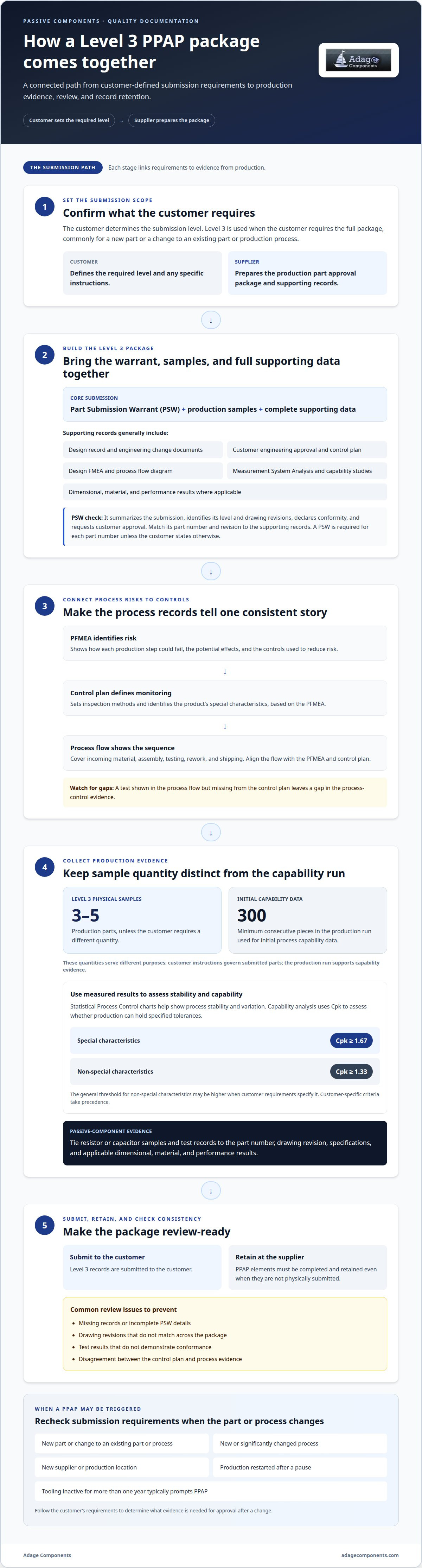
A Level 3 PPAP is the full submission: the supplier provides the Part Submission Warrant, production samples, and complete supporting data for customer approval. The PPAP Level 3 documentation requirements for passive components apply when the customer requires this submission level, commonly for a new part or a change to an existing part or production process.
The supplier prepares the package, while the customer determines which submission level applies. For resistors and capacitors, the evidence must connect the approved requirements to production results, including dimensional, material, and performance testing where applicable.
This guide explains who prepares a Level 3 PPAP and when it’s required, then outlines the records, process studies, and sample results that make up the package. It also shows how testing supports approval for passive components, so procurement and quality teams can align documentation with the customer’s requirements and keep the submission complete.
Key Takeaways
- The customer determines the PPAP submission level, while the supplier prepares the package and supporting records.
- A Level 3 submission combines the Part Submission Warrant and production samples with complete supporting data.
- Process studies connect the control plan and process risks to evidence of process stability and capability.
- Dimensional, material, and performance results show whether passive components meet the applicable requirements.
- Organize records around the part’s specifications and the customer’s requirements to make the submission easier to review.
What is a Level 3 PPAP submission?
A Level 3 PPAP submission gives the customer production samples and complete supporting data, alongside the Part Submission Warrant (PSW). The customer defines the required level, and the supplier prepares the production part approval package.
Level Three Package Contents
PPAP has five generally accepted submission levels, with different amounts of information sent to the customer. Level 1 contains the PSW; Level 2 adds samples and limited supporting data. Level 3 includes the PSW, samples, and complete supporting data. Level 4 contains the PSW and customer-defined requirements, while Level 5 makes the complete data available at the supplier’s manufacturing location.
A Level 3 package includes the design record, engineering change documents, customer engineering approval, and control plan. Supporting records generally include the Design FMEA, process flow diagram, Measurement System Analysis, capability studies, and dimensional, material, and performance results. These records connect the defined design and process requirements to evidence from production.
Approval, Retention, and Submission
The PSW is the package cover sheet. It summarizes the part submission, identifies its level and drawing revisions, declares conformity and requests customer approval. A PSW is required for each part number unless the customer states otherwise. Check that its part number and revision match the supporting records so the customer can review one coherent package.
Level 3 records are submitted to the customer and retained by the supplier. PPAP elements must still be completed and retained when they aren’t physically submitted. Common reasons for rejection include a missing record, mismatched drawing revisions, incomplete PSW details, or test results that don’t demonstrate conformance. A discrepancy between the control plan and process evidence can also undermine the package.
Sampling and Production Run Requirements
Level 3 physical samples are typically 3 to 5 production parts, unless the customer requires a different quantity. Initial process capability data should come from a minimum production run of 300 consecutive pieces. The sample quantity and production-run basis serve different purposes: customer-specific instructions govern submitted parts, while the run supports process capability evidence.
For passive components, tie sample identification and test records to the relevant part number and drawing revision. A resistor or capacitor sample should be traceable to the specifications and results in its package. If a production change affects the approved part or process, follow the customer’s submission requirements to determine what evidence is needed for approval.
Initial process studies
Initial process studies show whether production can repeatedly make parts that meet customer requirements. PPAP connects process risks and controls with measured production results before part approval.
Process Risk and Control Planning
The Process Failure Mode and Effects Analysis (PFMEA) identifies how each production step could fail, the potential effects and the controls used to reduce risk. The control plan is based on the PFMEA and defines inspection methods and the product’s special characteristics. Together, these records show how the supplier monitors identified failure modes during production.
The process flow diagram should cover incoming material, assembly, testing, rework and shipping. Its sequence must match the PFMEA and control plan. For a passive component, the documented flow might follow material receipt through forming, inspection and packing, if those steps apply. A test shown in the flow but missing from the control plan, for example, leaves a gap in the process-control evidence.
Capability and Production Validation
Initial process studies commonly use Statistical Process Control charts for critical characteristics. The charts help demonstrate process stability and variation, while capability analysis uses Cpk to assess whether production can hold specified tolerances. For special characteristics, Cpk of at least 1.67 is identified as the threshold for full approval. Results that fall short of expectations may require review and corrective action before resubmission.
For non-special characteristics, 1.33 is the general Cpk acceptance threshold, though customer requirements may be higher. These values guide interpretation; they don’t replace customer-specific criteria. The study must represent the actual production process, because PPAP evaluates the supplier’s ability to produce conforming parts during a run at the quoted production rate.
Tooling, Materials, and Change Triggers
Tooling and material controls belong in the study whenever they affect the production process or product characteristics. For molded parts, cavity-level results can reveal localized variation. In a 160-cavity tool, for example, cavities 40 through 50 might produce out-of-tolerance parts. Recording cavity identity can help pinpoint the source instead of treating every part as equivalent.
PPAP applies to a new part and to changes to an existing part or process. Triggers can also include a new or significantly changed process, a new supplier or production location, and restarting production after a pause. Tooling inactive for more than one year typically prompts PPAP. An engineering change or new tool can alter dimensions or process behavior, so the study must reflect the configuration submitted for approval.
For component categories and sourcing context, review the electronic component linecard alongside the part’s defined process and customer requirements.
PPAP preparation, record retention, and customer templates
PPAP preparation aligns the customer’s submission requirements with the supplier’s completed records, samples and approval request. The AIAG manual provides an industry reference, while customer-specific requirements define the package details.
AIAG and Customer Requirements
The Automotive Industry Action Group (AIAG) publishes the PPAP manual, which is in its 4th edition. IATF 16949 references PPAP as a customer-specific requirement, so the customer’s templates and instructions shape the submission. Requirements are usually negotiated during quoting, allowing the supplier and customer to define needed records, sample quantities, and approval criteria before production evidence is assembled.
Use the customer’s current forms where supplied, and map each requested field to a supporting record. For example, match drawing numbers and revisions on the Part Submission Warrant (PSW) to the design record and dimensional results. A customer template may also specify naming, format or submission-channel expectations. Consistent identifiers help engineering and quality teams review the same part configuration throughout the package.
Physical Parts and Samples
Physical PPAP samples are production parts submitted so the customer can assess them against the documented requirements. A Level 3 submission typically includes 3 to 5 production parts, unless the customer requires a different quantity. Identify each sample with its part number and revision, then keep those identifiers consistent with the PSW and test records.
A PPAP master sample is a final product sample inspected and signed off by the customer and supplier. It can serve as a quality-control benchmark and help train operators in subjective inspections. For passive components, this reference is useful when a characteristic requires consistent visual judgment, such as marking or finish. The customer determines whether an Appearance Approval Report applies, as it covers components affecting appearance.
Record retention is part of preparation, not an optional filing task. Complete and retain PPAP elements even when they aren’t physically submitted. Keep the final package together, including measurement results, approval records and the customer-specific template. A controlled record set lets the supplier trace the evidence supporting approval if a later engineering change affects the part or its production process.
Before submission, reconcile the PSW with the customer’s requested level, part number, drawing revision and conformity declaration. Confirm that sample identification matches those records and every required template field points to the right evidence. This final alignment helps avoid review delays caused by a missing form, inconsistent revision or sample that cannot be tied to its measurement data.
Dimensional, material, and performance testing
Level 3 test records show whether production parts conform to defined drawing and material requirements. For passive components, the package connects inspection results, laboratory evidence, and customer-specific acceptance criteria.
Ballooned Drawings and Dimensional Results
A ballooned drawing assigns an identifier to each drawing characteristic, linking it to a recorded measurement. This makes dimensional inspection results easier to trace and review against the approved design. Results commonly use a randomly selected sample of at least 30 pieces from a significant production run. Record the measured value for each characteristic, not only a pass result, so the reviewer can assess variation and tolerance conformity.
Include drawing dimensions and applicable general tolerances in the layout. ISO 2768-m is an example of a drawing note specifying general tolerances. The drawing revision, part number, sample identification, and measurement results should correspond. If a dimension falls outside tolerance, the record should identify the affected characteristic and part rather than obscure the deviation in an overall summary.
Material Test Results
Material test results show whether production material meets the customer’s defined specifications. Include applicable material certifications and test reports, tied to the part number and material identification. For passive components, the evidence may cover material characteristics named in the drawing or purchasing specification. The customer’s requirements determine which results and certifications belong in the PPAP submission.
Laboratory documentation matters when an in-house or contracted laboratory performs testing or material certification. Include documents and industry certifications for laboratories performing validation or material certification tests. Link the laboratory evidence to the relevant report so engineering reviewers can identify who performed the work and which material or characteristic the result covers.
Performance Testing and Compliance Documents
Performance results show whether parts meet the electrical or other functional characteristics defined for their application. For example, report a resistor’s or capacitor’s measured characteristics against its approved specification. Include the test method, result, acceptance criterion and sample identification when required by the customer. These records support the supplier’s ability to deliver conforming production parts.
Inspection and test records for passive components include dimensional layouts, material test results and applicable performance results. Material certifications and substance-compliance documents should address the customer’s defined material and substance requirements. Include supporting laboratory records when an internal or external laboratory performs validation or material certification tests. This keeps the evidence aligned with customer specifications without assuming that one substance document applies to every component.
Before submission, compare each report with the drawing revision and applicable specification. A measurement against an outdated tolerance, or a material certificate tied to a different identification, breaks traceability. The PPAP package should link each requirement to the sample and result, giving the customer a clear basis for approval or follow-up.
Passive-component documentation considerations
The PPAP Level 3 documentation requirements for passive components are strongest when each record connects a defined requirement to a production control and validation result. Resistors and capacitors may share a submission structure, but their critical characteristics differ. The customer’s drawing and specifications determine which dimensions, materials, and performance attributes require evidence. Treat each part number and revision as its own traceability thread across the package.
For a resistor, the applicable specification may identify resistance and tolerance as critical characteristics. For a capacitor, it may identify capacitance or another defined electrical characteristic. These examples don’t set universal acceptance limits. They show why the PSW, design record, test results and customer requirements must refer to the same approved configuration.
Manufacturing records should distinguish product characteristics from process controls. A control plan links a critical characteristic to its inspection or monitoring method, and supporting data shows what that control measured during production. If a drawing identifies a critical dimension, for example, the dimensional result should point to that requirement. This connection helps the customer assess both the part and the production process.
Passive-component material evidence also needs clear identification. Tie a material certification or laboratory result to the relevant part and material specification, rather than filing it as a general supplier document. For a resistor or capacitor, reviewers need to see which defined material requirement the record addresses. If a result covers only one material or characteristic, label its scope clearly to avoid implying broader validation.
Keep the package internally consistent across revisions and production records. A change to a drawing, material, supplier, manufacturing location, or production process can affect which evidence supports the approved configuration. The customer determines the applicable submission requirements. Applying the PPAP Level 3 documentation requirements for passive components means following each characteristic from its specification, through its control method, to the result and approval decision.
A useful review sequence is to map each critical characteristic to its evidence before submission:
- Identify the requirement in the customer drawing or specification.
- Locate the related process control and inspection record.
- Match the result to the correct part number and revision.
- Confirm that the part submission warrant describes that same configuration.
This traceability approach helps quality and procurement teams assess component documentation without treating every passive part as interchangeable. For component families and part categories, use the Adage Components linecard as a sourcing reference alongside the customer’s defined PPAP requirements.
Adage Components
Adage Components helps procurement teams source authentic components through vetted manufacturers and partner suppliers, many franchised by top 100 distributors. We support commercial and automotive grade components and comply with all ISO certifications. We offer one of the best costs in the industry, with manufacturer pricing and OEM pricing that provide the same advantages as buying from tier 1 distributors.
For supply needs, our amazing international logistics program and growing state-of-the-art warehouse support short lead times and integration with your MRP system, helping products reach your facility in real time, on time. Explore our electronic component linecard when aligning component sourcing with your production requirements.
Align Your Next Sourcing Decision
A disciplined approach to PPAP Level 3 documentation requirements for passive components can also inform sourcing decisions. Use the component specification and customer-defined requirements to keep procurement, engineering, and quality aligned before a part enters production. That connection helps teams assess component choices in the context of the validation evidence they will need.
Adage Components offers Thick Film Chip Resistors, Thin Film Precision Resistors and Carbon Film Resistors. These options can support sourcing discussions for programs where component fit and documentation expectations need to be considered together. Base the decision on approved requirements, rather than treating a part number alone as evidence of suitability.
To review resistor options for your program, explore component options with Adage Components. A clear sourcing conversation is a practical next step toward keeping your component requirements and production plans aligned.
Frequently Asked Questions
Who does the PPAP and when is it required?
The supplier prepares the PPAP package, and the customer determines the required submission level. PPAP is commonly required for a new part or a change to an existing part or production process. Other triggers can include a new supplier or production location, a significantly changed process or restarting production after a pause. The evidence must reflect the part and process configuration submitted for approval.
Why is PPAP important?
PPAP gives the customer evidence that a supplier can produce parts consistently to defined requirements during an actual production run at the quoted production rate. It helps identify gaps between engineering intent and manufacturing output before regular production relies on the process. For example, a capability result can show that corrective action is needed before the customer accepts the part for ongoing supply.
What is Production Part Approval Process (PPAP)?
Production Part Approval Process (PPAP) is a structured submission for obtaining customer approval of a production part and its manufacturing process. It connects design requirements with process documentation, inspection results and production samples. The supplier uses the package to demonstrate conformity; the customer reviews it against applicable requirements and records an approval decision. PPAP applies to a defined part and production configuration.
Who Governs PPAP Standards?
The Automotive Industry Action Group (AIAG) publishes the PPAP manual, which serves as an industry reference. The customer determines the submission level and may set additional customer-specific requirements. IATF 16949 references PPAP as a customer-specific requirement, so the manual alone does not determine every package detail. In practice, supplier and customer requirements work together: the manual provides the framework, while customer instructions define the submission expected.
What documents are required in a PPAP Level 3 submission?
A Level 3 package generally includes the Part Submission Warrant, design record, engineering change documents, customer engineering approval, control plan, and dimensional results. Supporting records include the Design FMEA, process flow diagram, Measurement System Analysis, capability studies, and applicable material and performance test results. Customer-specific templates can add requirements. Each document should identify the same part number and revision, so the reviewer can trace evidence to the approved configuration.
Which PPAP requirements apply specifically to passive electronic components?
Passive components follow the same PPAP framework, but the customer’s drawing and specifications determine which characteristics need validation. A resistor, capacitor or inductor may need documented dimensional, material and performance evidence relevant to its defined requirements. Tie each result to the part number, revision, sample and test record. No single passive-component checklist replaces the customer-specific requirements for a particular part.
What are the PPAP 18 elements and which are required for Level 3?
The 18 elements are the PPAP framework’s categories of design, process, measurement, testing, and approval evidence. Level 3 calls for the complete supporting data package, including applicable design records, process documentation, measurement studies, capability results, test records, samples, and the Part Submission Warrant. Elements must be completed and retained even when they aren’t physically submitted. The customer’s instructions define any specific exceptions or additional requirements.
What customer-specific PPAP requirements apply to capacitors, resistors, and inductors?
Customer-specific requirements define the characteristics, tests, formats and sample expectations for each capacitor, resistor or inductor. The applicable drawing and specification determine which results matter; parts in the same category can require different evidence. For example, use the customer’s named performance characteristics rather than assuming a generic test list applies. Align the control plan and reports with those requirements, then retain the supporting records.
Disclaimer
Cross-referenced components needs to be confirmed by the client with either spec. sheet or samples or both.
Please note, we use AI to help us, information is verified to be correct but we can not guarantee 100% accuracy.