

A second source is a risk-control decision, not simply another name on the approved vendor list. To convince production leadership to qualify a second source for passives, connect the proposal to a specific supply, quality, lifecycle, or cost risk, then show how qualification will help control it. A second source means having two qualified suppliers, not merely identifying an alternative part.
The case needs to work for production, engineering, quality, and purchasing. Leadership needs to see the operational reason to act, the evidence required to approve the part and supplier, and who owns each decision. Match the qualification path to the risk of the BOM line instead of applying the same effort to every passive.
This article explains how to build the case, choose a practical qualification path, set approval gates, and assign clear ownership. You’ll learn how to distinguish a candidate from a qualified source, plan validation under production conditions, and define how the alternate will be used once approved. The result is a disciplined proposal that addresses continuity without treating quality controls as an afterthought.
Key Takeaways
- Prioritize second-source candidates by the operational and sourcing risk of each BOM line, then assess the manufacturer, plant, and production process.
- Use distinct approval gates for supplier capability and part validation instead of relying on a single supplier score or acceptable sample.
- Build the business case around a specific supply, quality, lifecycle, or cost exposure, with a named owner accountable for the decision.
- Assign clear roles across purchasing, engineering, quality, logistics, management, and customer approval so qualification work has coordinated ownership.
- Set engineering tests for alternate resistors, capacitors, and inductors around their requirements and intended production conditions.
How does a second source get onto the approved vendor list?
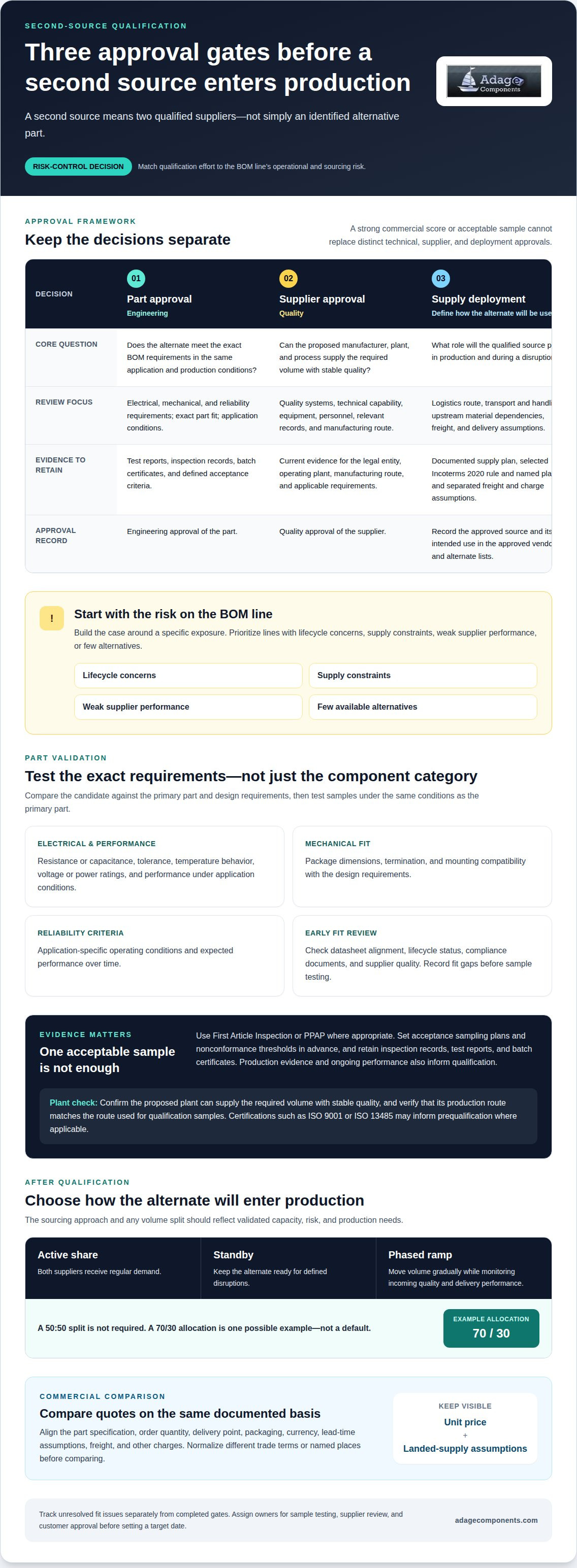
Start with the BOM line and document its required electrical, mechanical, and reliability characteristics. To establish interchangeability, the alternate must meet those requirements in the same application and production conditions as the primary part.
-
Assess Manufacturer, Plant, and Process Capability
Assess the manufacturer and the specific plant proposed for production, not just the supplier’s corporate profile. Build current evidence around the legal entity, operating plant, manufacturing route, and exact requirement. Review quality systems, technical capability, equipment, personnel, and relevant records. Certifications such as ISO 9001 or ISO 13485 may inform prequalification where applicable.
Then confirm the plant can supply the required volume while maintaining stable quality at that volume. A capable manufacturer may still have a plant or process mismatch. Record those gaps before advancing the candidate, and identify whether the proposed route matches the one used for qualification samples.
-
Assess Single-Source BOM Risk
Assess the consequences of losing the current source for each BOM line. Flag parts with lifecycle concerns, supply constraints, weak supplier performance, or few alternatives. A second source generally means two qualified suppliers, but the appropriate level of control depends on each line’s operational and sourcing risk.
Compare the candidate with the exact part requirements, not just a broad component category. Check datasheet alignment, lifecycle status, compliance documents, and supplier quality. A resistor with a similar nominal value may still differ in tolerance, package, or performance under application conditions. Record any fit gaps early so engineering can reject a poor match before sample testing.
-
Define Tests and Interchangeability Requirements
Define engineering tests before requesting approval. Compare resistance or capacitance, tolerance, temperature behavior, voltage or power ratings, package dimensions, termination, and mounting compatibility with the design requirements. Add application-specific reliability criteria, including operating conditions and expected performance over time.
Test samples under the same conditions as the primary part. Use First Article Inspection or PPAP where appropriate, and set acceptance sampling plans and nonconformance thresholds in advance. Retain inspection records, test reports, and batch certificates. One acceptable sample is not enough: production evidence and ongoing performance also inform qualification.
-
Estimate Qualification Time
Build the schedule around the component, evidence, and approval path. Qualifying a second source for a passive can take days, while engineering validation, sample availability, production trials, and customer approval can extend the work. Identify these dependencies before setting a target date.
Start during research and development or the final pilot run, rather than waiting for a shortage. Assign owners for sample testing, supplier review, and customer approval. Track unresolved fit issues separately from completed gates. This gives production a clear view of what remains before the alternate can be added to the approved vendor list.
Using qualification gates instead of a single supplier score
Separate technical approval, supplier approval, and supply deployment into distinct gates. This makes each decision traceable and prevents a strong commercial score from masking an unresolved quality or logistics risk.
-
Set Qualification Gates
Define pass-or-hold criteria for every gate before reviewing the candidate. Engineering approves the part, while quality approves the supplier. Record both decisions in the approved vendor and alternate lists. A single weighted score can hide a failed technical requirement behind a strong price or delivery rating. Keep the evidence and accountable approvers visible at each gate.
-
Review Logistics and Upstream Dependencies
Map the route from the manufacturing plant to your receiving point, including transport, handling, and upstream material dependencies. Record the selected trade rule and named place using Incoterms 2020, then expose freight and charge assumptions separately. This gives purchasing a comparable view of delivery exposure, not just a supplier’s quoted lead time. A component line card can help frame which component families belong in the sourcing review.
- Choose how the qualified source will enter production. Active share places both suppliers in regular demand; standby keeps the alternate ready for defined disruptions. A phased ramp moves volume gradually while teams monitor incoming quality and delivery performance. A 50:50 split isn’t required. A 70/30 allocation is one possible example, but the split should reflect validated capacity, risk, and production needs.
- Compare supplier quotes on the same documented basis. Align the part specification, order quantity, delivery point, packaging, currency, lead-time assumptions, freight, and other charges. Separate quoted unit price from landed-supply assumptions so the team can see what drives the difference. If suppliers quote different trade terms or named places, normalize them before comparing the commercial position.
- Set performance measures and change controls before release. Track delivery against commitments, incoming defects, nonconformance closure, and actual supplied volume. Require notification of process, material, or manufacturing-location changes that could affect form, fit, or function. A change should trigger a defined review, not informal acceptance based on the supplier relationship.
- Schedule recurring reviews of both sources and their upstream dependencies. Capacity, transport routes, technical teams, and material availability can change after approval. Document review outcomes and update the approved alternate record so buyers can act during an urgent supply decision. A source qualified years ago but never used may not perform as expected without current evidence.
Building a business case and defining a decision owner
Build the proposal around a specific BOM risk, a measurable business consequence, and one accountable decision owner. This helps production leadership weigh continuity against the effort required for qualification.
- Identify the exposure. Select the passive parts whose loss would affect production, customer commitments, or product lifecycle plans. Show the current source position, known constraints, and operational consequences of an interruption. Separate high-impact items from low-cost passives with several interchangeable manufacturers. For the latter, additional qualification effort may not justify the risk reduction.
- Compare the cost of action with the cost of exposure. Include engineering time, samples, testing, production trials, and ongoing supplier oversight in the qualification effort. Compare these activities with the likely operational burden of a shortage, end-of-life transition, or recurring supplier issue. Keep assumptions visible so leadership can see what drives each side of the comparison.
- Use historical cases carefully. The lifecycle costs of 14 U.S. Department of Defense tactical missile programs second sourced between 1975 and 1995 were reduced by 20 percent. A Navy missile second-sourcing program was estimated to save $630 million through FY 1994. These examples show potential program-level value, not a guaranteed result for a passive-component BOM.
- Define the decision owner. Name one production or operations leader accountable for the go, hold, or stop decision. Engineering should own technical acceptance, quality should own supplier approval, and purchasing should document commercial assumptions. The decision owner resolves trade-offs when functions disagree, records the rationale, and ensures the approved alternate has a defined production-use strategy.
- Set decision criteria before requesting approval. Tie the proposal to the affected BOM lines, supply-chain exposure, required evidence, and intended use of the alternate. State what would trigger active use, standby status, or further review. This keeps the request focused on risk control rather than a broad appeal for more suppliers.
- Present a concise decision brief. Summarize the risk, expected qualification work, unresolved dependencies, accountable owner, and approval requested. Separate established facts from assumptions. Ask leadership to approve a specific path, such as beginning validation for a high-risk line, rather than endorsing an open-ended sourcing strategy.
Cross-functional management case for qualifying a second source
Treat second sourcing as an operational program, not just a purchasing task. Assign each function a decision and handoff before qualification begins.
- Set a shared continuity objective. Purchasing identifies exposed BOM lines and supply constraints. Production defines the operational impact of a shortage, including schedule disruption and line changeovers. Engineering explains technical dependencies, while quality defines the evidence needed for supplier and part approval. Agree on one objective, such as protecting production continuity for a specific assembly, to keep teams focused on the same outcome.
- Give each function a defined responsibility. Purchasing manages supplier communication and commercial terms. Engineering owns component fit and validation. Quality controls supplier approval, inspection records, and nonconformance escalation. Logistics maps transport routes, delivery assumptions, and receiving requirements. Production confirms trial timing and acceptable operating conditions. Name a lead to track handoffs, resolve stalled decisions, and report open actions to management.
- Bring customer approval forward. Identify affected customer programs before selecting a production switch date. Customer approval can take time, so include it in the qualification schedule rather than treating it as a final release formality. Engineering supplies technical evidence, quality provides supporting records, and the program owner coordinates the submission. This prevents an internally approved alternate from remaining unusable for a customer-controlled assembly.
- Connect logistics to the production plan. Have logistics assess the source’s shipping route, delivery assumptions, and receiving handoffs alongside purchasing’s supply plan. Production should identify when a trial can run without disrupting the scheduled build. If the alternate depends on a different transport route or replenishment pattern, document the operational effect and align inventory planning before activation.
- Make ownership visible in team measures. Add second-source milestones to relevant purchasing, engineering, and quality KPIs. Track completed reviews, validation status, approval decisions, and documented alternate use. Keep measures tied to work each function controls. Management can then see whether delays stem from technical testing, supplier evidence, customer review, or logistics planning, rather than treating qualification as one undifferentiated task.
- Review barriers and adjust the plan early. Hold a cross-functional review when a gate stalls or requirements change. Engineering may identify a fit issue, quality may request more production evidence, or logistics may flag a delivery dependency. Record the issue, owner, next action, and decision date in the program record. Consider incentives for completed milestones, but never reward approval that bypasses technical or quality controls.
The management case is strongest when every team understands its role, decisions, and operational impact before a supply disruption forces action.
What engineering tests are required to qualify alternate resistors, capacitors, and inductors?
Set the test plan against the component’s design requirements and intended operating conditions. Engineering should compare the alternate with the primary part under the same conditions, then document results before production approval.
- Establish the baseline. Record the primary part’s datasheet limits, package, termination, and application conditions. For a resistor, identify resistance, tolerance, power rating, and temperature behavior. For a capacitor, define capacitance, voltage rating, ESR, and ripple-current requirements where applicable. For an inductor, capture inductance, DCR, and saturation-current requirements. Use the design’s actual requirements, not a generic component-family checklist.
- Check electrical performance. Measure the alternate against the baseline with suitable test equipment and specified test conditions. Confirm resistance or capacitance remains within design limits across relevant operating conditions. For inductors, compare inductance and DCR, then assess saturation behavior if the circuit depends on it. A matching nominal value alone does not establish equivalent electrical performance.
- Assess temperature and operating stress. Define the temperature range and electrical loading based on the application. Evaluate whether resistor drift, capacitor behavior, or inductor performance remains acceptable under those conditions. Include voltage, current, power, and relevant thermal effects in the plan. Record the test setup and results so engineering can distinguish component differences from measurement variation.
- Verify mechanical and assembly fit. Compare body dimensions, lead spacing or termination geometry, mounting orientation, and clearance with the board layout. Run the candidate through the intended assembly process, then inspect placement, solder joints, and visible damage. A part that passes bench measurements may still create production issues if its footprint or termination behaves differently during assembly.
- Plan reliability evidence for the application. Select stress tests based on the product’s operating environment and failure consequences. Examples include temperature cycling, operating-life evaluation, or vibration exposure when relevant. Set acceptance criteria before testing, and preserve sample identification, test conditions, inspection records, and failure analysis. Do not treat one acceptable sample as proof of sustained production performance.
- Validate with production evidence. Run a controlled pilot using the same process and inspection criteria planned for routine builds. Monitor defect rates, process capability, and any electrical shifts after assembly. Compare results with the primary part, document deviations, and route failures to engineering and quality for disposition. Release the alternate only when the required technical and production evidence supports approval.
Use the passive component line card to identify component families for a focused qualification plan.
Adage Components
Adage Components supports second-source planning with authentic components from vetted manufacturers and partner suppliers, many franchised by top 100 distributors. We comply with all ISO certifications and support commercial and automotive grade components. Our Thick Film Chip Resistors, Thin Film Precision Resistors, and Carbon Film Resistors give teams component options to assess against their requirements. Customers get manufacturer pricing and OEM pricing, with the same advantages as buying from tier 1 distributors but at OEM pricing, alongside one of the best costs in the industry. Our international logistics program and growing state-of-the-art warehouse support short lead times and delivery to your facility in real time, on time. The service is perfect for your MRP system.
Move the Qualification Decision Forward
Choose a BOM line where a sourcing change could affect production, then define what your team needs from an alternate. A focused request gives the sourcing discussion a practical starting point and connects component options with your cost targets and operational requirements.
Share your component needs and sourcing priorities with Adage Components to discuss an appropriate next step. Contact Adage Components about sourcing options for your production requirements.
Frequently Asked Questions
What Happens When Everyone Needs a Second Source?
Prioritize the parts with the greatest production impact instead of qualifying every BOM line at once. If engineering, purchasing, and production flag different components, use product dependencies and shortage consequences to set the sequence. Then schedule shared resources, such as lab testing and pilot-build capacity, around the highest-priority candidates. This prevents competing requests from creating a qualification backlog or delaying alternates that matter most for continuity.
Can the Second Supplier Deliver the Required Volume?
Production evidence and capacity information are needed to establish whether the supplier can support the required volume. Review the proposed plant’s available capacity, production route, and ability to maintain stable quality at expected demand. Also consider whether upstream materials or other customer commitments constrain supply. A successful sample run demonstrates part performance, but does not by itself show that the supplier can sustain ongoing production deliveries.
Does a Second Source Need to Be a Drop-In Replacement?
No. A candidate may meet the electrical requirements but still need a footprint change, assembly adjustment, or design review. For example, a passive with a different package may require a board-layout assessment even when its nominal electrical value matches. Engineering should define whether the program requires a drop-in replacement or can accept a controlled design change. Customer approval may also determine whether the alternate can be used in a particular product.
What Is Second Sourcing in Electronic Components?
Second sourcing means qualifying another supplier for the same component requirement, giving the product two approved sources. The alternate may be the same manufacturer’s part or a component from a different manufacturer. The key distinction is approval: a catalog match or available sample remains a candidate until the relevant technical and supplier reviews are complete. Document the approved part and source so production teams can identify the authorized option.
What are the disadvantages of second sourcing?
Second sourcing adds work and can create new control points. Engineering and quality must review the alternate, while purchasing and production manage supplier records, orders, and change notifications. If demand is divided, each supplier may receive less volume, which can complicate planning. An approved source that is rarely used can also lose practical readiness as processes or capacity change. Limit these burdens by focusing on BOM lines with meaningful exposure.
What is the difference between dual sourcing and multiple sourcing?
Dual sourcing uses two approved suppliers for a requirement; multiple sourcing uses more than two. Either approach can support resilience, but both add coordination across supplier records, quality oversight, and purchasing. For example, a team might maintain one primary supplier and one qualified standby source rather than split orders. The right arrangement depends on supply risk, operational impact, and the organization’s ability to manage each relationship effectively.
What are the total costs of qualifying a second source versus the cost of a production disruption?
Compare the internal effort to qualify the source with the operational consequences of a disruption. Include engineering and quality labor, samples, testing, audits, production trials, and continuing supplier oversight. For disruption exposure, account for idle production capacity, rescheduling, expedited freight, customer impacts, and recovery work. Use the same time horizon and BOM line for both views. Make assumptions visible rather than treating avoided disruption as guaranteed savings.
How can a business case persuade production leadership to fund second-source qualification?
To convince production leadership to qualify a second source for passives, connect an exposed BOM line to a specific operational consequence and a defined approval request. Show the qualification work, resource owners, customer dependencies, and intended use of the alternate. For example, propose validating a standby source for a part that could halt a build, rather than requesting broad approval across the BOM. A concise case lets leaders assess the risk and authorize a clear next step.
Disclaimer
Cross-referenced components needs to be confirmed by the client with either spec. sheet or samples or both.
Please note, we use AI to help us, information is verified to be correct but we can not guarantee 100% accuracy.