

A high-temperature storage test can expose automotive passives to 125-150°C for several hundred hours, but the applicable profile depends on component qualification and OEM requirements. The high temperature storage test standards for automotive grade passives must be read alongside the relevant AEC-Q200 or AEC-Q100 grade and the component’s intended operating conditions.
It’s reasonable to expect a single grade or test duration to settle qualification, but storage exposure is only one part of the decision. Temperature grades can help frame component suitability, but they should be considered alongside application requirements. OEM requirements and lifetime targets add context to what a qualification result means for a specific application.
This guide explains how high-temperature storage testing relates to AEC-Q200 and AEC-Q100 grades, how OEM requirements can shape validation, and how lifetime targets inform component selection. You’ll get a clearer framework for interpreting test conditions and connecting qualification requirements to automotive passive-component sourcing.
Key Takeaways
- Understand why high-temperature storage exposure, such as 125-150°C for several hundred hours, is only one part of automotive passive qualification.
- See how AEC-Q200 qualification and OEM requirements shape the tests used to assess a passive component.
- Distinguish the role of AEC-Q100 Grades 2 and 3 from the temperature grades used for passive components.
- Use AEC-Q200’s five temperature grades, from Grade 0 through Grade 4, to frame component temperature suitability.
- Connect test results with automotive lifetime targets, then assess how component selection supports your application requirements.
High-temperature storage exposure testing
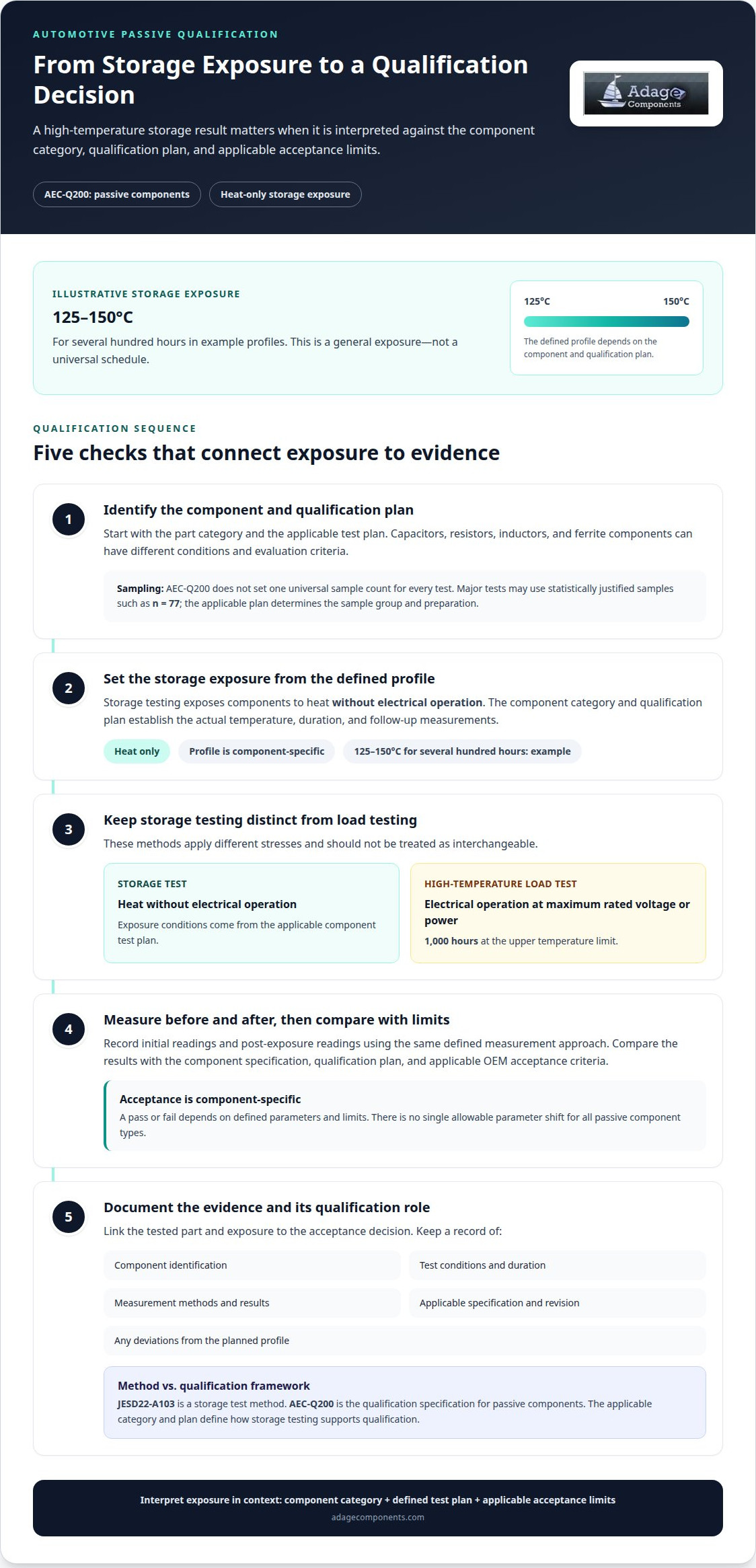
High-temperature storage exposes components to heat without electrical operation. Example profiles use 125-150°C for several hundred hours, but the component category and qualification plan shape the specific exposure.
These high temperature storage test standards for automotive grade passives distinguish heat-only storage from a high-temperature load test. A load test operates components at maximum rated voltage or power for 1,000 hours at the upper temperature limit. The two methods assess different stresses and shouldn’t be treated as interchangeable.
Storage Test Conditions by Component Type
Storage conditions vary by component type, defining the temperature, duration, and evaluation criteria for each passive category. This matters because capacitors, resistors, inductors, and ferrite components have different characteristics and qualification plans.
The example of 125-150°C for several hundred hours describes a general exposure, not a universal schedule. AEC-Q200 covers passive categories including capacitors, resistors, and inductors. The applicable test plan establishes conditions for each category, including ferrite components, and identifies which measurements follow exposure.
To determine component-specific storage requirements, interpret the high temperature storage test standards for automotive grade passives in light of the part category and qualification plan. A general example cannot replace the defined test profile and evaluation criteria.
JESD22-A103 and AEC-Q200 Comparisons
JESD22-A103 and AEC-Q200 have different roles in qualification planning. JESD22-A103 is a storage test method, while AEC-Q200 is the Automotive Electronics Council’s qualification specification for passive components.
They aren’t interchangeable labels. A test method describes an approach to exposure; AEC-Q200 places passive-component testing within a qualification framework. The applicable category and qualification plan establish how storage testing supports the component’s qualification.
Acceptance Criteria and Parameter Shifts
Acceptance criteria determine whether measured characteristics remain within applicable limits after storage exposure. A pass or fail depends on the component’s defined parameters, not simply the exposure temperature.
Compare pre-test and post-test measurements against the limits in the component specification and qualification plan. There is no single allowable parameter shift for capacitors, resistors, inductors, and ferrite components. Relevant characteristics and criteria depend on the component.
Document the component identification, test conditions, exposure duration, measurement methods, and results in the qualification record. Include the applicable specification and revision, as well as any deviations from the planned profile. This links the tested part and its exposure to the acceptance decision.
AEC-Q100 applies to semiconductor devices, while AEC-Q200 addresses passive components. Gravity-handler IC testing is a separate production-test issue. Temperature curves at 125°C and −40°C show an approximately 20°C shift and remain unstable until three to five seconds into testing. A typical analog IC production test lasts five to eight seconds.
For the described overdrive approach, setting a handler to 145°C targets testing at 125°C. This concerns IC test temperature control, not passive storage qualification. Keeping the procedures distinct prevents a semiconductor production-test condition from being mistaken for an AEC-Q200 storage profile.
AEC-Q200 qualification and OEM requirements
AEC-Q200 provides a qualification framework for passive components, while OEM requirements define application-specific expectations. Reliability decisions depend on matching the component category, test evidence, and environmental demands.
Sample Sizes and Preconditioning
Sample size and preconditioning define how test parts are selected and prepared before qualification exposure. Consistent selection and preparation support meaningful comparisons between test results and acceptance limits.
AEC-Q200 does not imply one universal sample count for every test. Major tests may use statistically justified samples such as n = 77. The applicable test plan determines the sample group, component category, and any preparation needed before exposure.
Keep each selected sample linked to its part identification and qualification record. If an OEM requires a different sample plan or preconditioning sequence, document that requirement against the relevant test and component characteristics.
Measurement Procedures
Measurement procedures define which characteristics to record before and after testing and how to compare the results. A consistent approach helps distinguish genuine parameter changes from measurement variation.
For storage-related qualification, record initial readings, test conditions, and post-exposure readings using the same defined measurement approach. Compare the results with the applicable component limits and OEM acceptance criteria.
Document the equipment, methods, sample identification, and any deviations. This record links a measured failure or parameter shift to the tested component and environmental exposure, making the result easier to interpret.
AEC-Q200 Revision E is dated March 2023 and expands the specification’s scope from 14 to 16 product categories. That change matters when teams use older qualification matrices: category coverage should align with the revision governing the program, not simply with a familiar test list.
AEC-Q200 covers passive components including capacitors, resistors, inductors, transformers, crystals, and fuses. Its requirements are not identical across those categories. For example, Table 5 lists 18 required or conditional tests for magnetic devices such as inductors and transformers. The test matrix therefore needs to match the device type.
OEM requirements add application context to qualification. An automaker may specify additional environmental validation, documentation, or acceptance criteria for its vehicle program. ISO 16750 and LV 123 are also named as standards for validating passives against full-vehicle durability demands. They serve a different purpose from component qualification alone.
For a clear review, map each requirement to the part category, test, sample plan, measurement, and acceptance criterion. Record the applicable AEC-Q200 revision and any OEM-specific additions. This makes gaps visible before qualification results support a sourcing or design decision.
Once the required passive categories are clear, the component line card from Adage Components can help connect qualification scope with component-family sourcing.
OEM programs may also introduce custom screening or reporting formats beyond the baseline qualification. For thermal cycling, the standard requirement for automotive passives is -40°C to +125°C and 1000 cycles; the standard thermal-cycling requirement is 1000 cycles. Vibration test conditions should be matched to the component and its application. These conditions should be checked against the OEM’s application-specific validation plan, with results and deviations recorded against the relevant component and test.
AEC-Q100 Grades 2 and 3
AEC-Q100 qualification applies to integrated circuits and other semiconductor devices, not passive components. Grades 2 and 3 help classify an IC’s temperature qualification, but they don’t replace application-specific validation or passive-component qualification under AEC-Q200.
This distinction matters when an automotive design combines ICs, resistors, capacitors, and inductors. A grade assigned to one semiconductor device does not establish the storage performance of surrounding passive parts. Assess each component family against its relevant qualification basis and test evidence.
For an IC, use the grade specified for the device and consider the application’s temperature demands. The qualification decision should account for where the circuit operates, the stresses it experiences, and its role in the vehicle system. A component in an extreme under-hood environment may face different demands from one in a protected cabin module.
Grade selection is not a substitute for examining the full qualification record. Review the device identity, applicable AEC-Q100 qualification, test results, and the conditions those results represent. Then compare them with the intended application. If circuit operating conditions fall outside the assumptions represented by the selected grade, the grade alone cannot establish suitability.
Keep functional safety separate from temperature classification. AEC-Q100 qualification addresses device reliability under defined qualification testing; it does not by itself establish a system’s functional-safety performance. The system design must account for the IC’s function, failure effects, and how the surrounding circuit responds to faults.
Vibration and other vehicle stresses also require application-level consideration. A temperature grade does not describe every environmental exposure a device may experience. Review qualification evidence in light of the vehicle location, circuit function, and OEM requirements. This avoids treating a temperature classification as a complete durability statement.
For procurement and design reviews, keep semiconductor and passive evidence distinct. Use AEC-Q100 records for ICs, and use the applicable passive qualification evidence for components such as capacitors, resistors, and inductors. AEC-Q200’s temperature grades are a separate classification; don’t transfer those values to AEC-Q100 Grade 2 or Grade 3.
Separating these factors makes qualification decisions more precise. It helps identify which devices have relevant evidence, which circuit risks still need review, and where OEM requirements call for testing beyond component qualification. The result is a clearer link between grade selection, application stresses, and the intended reliability target.
AEC-Q200 temperature grades
AEC-Q200 has five temperature grades, from Grade 0 through Grade 4. Each grade identifies a temperature range for passive-component suitability, but the grade alone doesn’t describe every operating or storage condition in a vehicle.
The AEC-Q200 ranges are:
- Grade 0: -55°C to +165°C
- Grade 1: -40°C to +125°C
- Grade 2: -40°C to +105°C
- Grade 3: -40°C to +85°C
- Grade 4: 0°C to +70°C
These values help connect a component’s temperature classification with its intended environment. For example, Grade 1 covers -40°C to +125°C, while Grade 3 covers -40°C to +85°C. That difference can matter when a passive sits near a heat source rather than in a temperature-controlled cabin area. The vehicle location and expected operating conditions guide which range is relevant.
Operating temperature ratings differ from high-temperature storage test limits. A rating describes the component’s specified temperature range for operation, while storage testing exposes an unpowered part to a defined temperature and duration. An example storage exposure is 125-150°C for several hundred hours; it shouldn’t be treated as an operating rating.
Keep the grade and test profile separate in the specification. A Grade 1 designation doesn’t, by itself, state that a part must undergo a particular storage duration. The qualification plan identifies the applicable exposure, measurements, and acceptance criteria. OEM requirements may add conditions for the vehicle application, so the grade is one input rather than a complete environmental validation.
Temperature classification does not define voltage capability. A passive’s electrical limits and temperature range are separate characteristics. For example, assess a capacitor’s specified voltage alongside its grade and the circuit’s operating conditions. The same principle applies to resistors and inductors: a suitable temperature range does not establish every electrical or functional requirement.
Use the five AEC-Q200 grades as a screening framework, then match the selected component’s specification to its application. A Grade 2 part spans -40°C to +105°C, while Grade 4 spans 0°C to +70°C. That contrast can quickly identify a range mismatch, but it doesn’t replace review of test evidence or OEM-specific criteria.
For a procurement or design review, record the selected AEC-Q200 grade, the component’s operating range, and any separate storage exposure requirement. Then compare those details with the vehicle location and circuit conditions. This keeps qualification decisions precise: the grade communicates temperature classification, while the test plan establishes how storage performance is evaluated.
Automotive passive-component lifetime targets
Automotive passive lifetime targets connect qualification evidence with the service life expected from vehicle electronics. Lifetime targets can help frame qualification requirements for automotive passives. Some programs describe an extended expectancy of 15-20 years, alongside a 0 ppm critical target. These figures represent different levels of ambition, not interchangeable guarantees.
A lifetime target needs context. The component’s operating temperature ranges, electrical stress, and location within the vehicle affect its exposure. A passive near a heat source faces a different thermal profile from one in a protected cabin circuit. These application conditions shape how relevant a qualification result is to the intended service life.
Test duration alone does not translate directly into years of field life. High-temperature storage examines heat exposure without operation, while an operating component also experiences electrical conditions and changing loads. Engineers interpret storage results alongside other qualification evidence and the operating conditions expected in the vehicle.
Thermal cycling provides another useful reliability measure. An advanced automotive validation target is 3000 cycles, which subjects a component to repeated temperature changes. That cycle count is not a direct lifetime conversion. It represents a stress test, and its value depends on the temperature range and the component’s measured response.
For an electronics program, distinguish three items in the qualification record: the lifetime target, the test conditions, and the acceptance limits. A 10-year target describes an intended service-life objective. A storage or cycling test describes a defined exposure. Acceptance criteria determine whether measured characteristics remain within required limits after that exposure.
The 15-20-year expectancy and 0 ppm critical target indicate a more demanding reliability objective than the commonly cited 10-year target. The 0 ppm figure is a target, not evidence that failures are impossible. A program must connect this objective to its component criticality, environmental exposure, and qualification evidence.
Use lifetime targets to guide component evaluation, not to replace it. Compare the expected operating conditions with the component’s temperature classification and the test evidence available for its application. Then identify whether the program’s target aligns with standard requirements or calls for extended validation, such as the 3000-cycle thermal-cycling target.
Clear sourcing begins with matching component categories to the design’s qualification and lifetime needs. Review component categories for automotive designs as you align passive requirements with your program’s target.
Mechanical shock should be considered alongside thermal evidence when an application may expose a component to abrupt physical loading. Example conditions for a mechanical shock test of automotive passive components are 1500 g and 0.5 ms. Treat these as stated test conditions, not as a service-life estimate or an automatic pass criterion. In reviewing results, keep the applied shock conditions linked to the component evaluated and the acceptance limits used by the program. This makes the evidence easier to compare with the intended installation and supports a clear decision about whether the available qualification record addresses the stresses relevant to that vehicle application.
Adage Components
Adage Components helps procurement teams source authentic commercial and automotive-grade components through vetted manufacturers and partner suppliers, many franchised by top 100 distributors. We support compliance with all ISO certifications and offer Thick Film Chip Resistors, Thin Film Precision Resistors, Carbon Film Resistors, and MELF Resistors. With one of the best costs in the industry, we provide manufacturer pricing and the same advantages as buying from tier 1 distributors but at OEM pricing. Our amazing international logistic program and growing state-of-the-art warehouse support short lead times and real-time, on-time delivery to your facility, integrated with your MRP system.
For resistor sourcing aligned with your qualification and supply-chain requirements, contact Adage Components.
Turn qualification requirements into sourcing decisions
Turn your qualification criteria into a component brief that supports engineering approval and procurement decisions. Clear requirements help align authentic part selection with cost-effective sourcing, manufacturer pricing, and logistics for your supply plan. The high temperature storage test standards for automotive grade passives are one part of that brief, alongside the needs of your specific application.
For component options that fit your program, review the Adage Components line card and move your sourcing decision forward with confidence.
Frequently Asked Questions
What additional high-temperature storage requirements do automakers or OEMs specify beyond AEC-Q200?
Automakers may add application-specific environmental validation, documentation, or acceptance criteria beyond AEC-Q200. ISO 16750 and LV 123 are additional standards used to validate components against full-vehicle durability demands, not universal high-temperature storage profiles. For a particular part, map each OEM requirement to its applicable exposure conditions, measured characteristics, and pass/fail limits. This makes program-specific expectations distinct from the baseline component qualification.
Disclaimer
Cross-referenced components needs to be confirmed by the client with either spec. sheet or samples or both.
Please note, we use AI to help us, information is verified to be correct but we can not guarantee 100% accuracy.