

A competitive quote means little if component authenticity, technical fit, or delivery timing puts production at risk. A passive electronic distributor supplies parts such as resistors and capacitors. The right sourcing partner also aligns quality controls and procurement with your production requirements. Choosing one is about more than price: it can affect supply continuity and confidence in the components entering your assembly process.
That’s why procurement teams assess more than a part number and a quoted lead time. They need to understand where components come from, how quality is evaluated, whether the supplier can support regional requirements, and how well its services fit existing purchasing workflows.
This article explains how to evaluate those factors when choosing a passive electronic distributor. You’ll learn what to look for in authenticity controls, purchasing fit, regional reach, technical support, and supply chain services, so you can compare partners against the needs of your operation and make a more informed sourcing decision.
Key Takeaways
- Assess component authenticity through traceable sourcing and clear quality controls, not price or availability alone.
- Match a distributor’s purchasing approach to your BOM, production demand, and MRP workflow to support supply continuity.
- Evaluate regional reach by how well logistics and technical support align with the needs of your facilities.
- Clarify the role of an electronics distribution partner in sourcing, component quality, and supply chain coordination.
- Compare component options and sourcing fit to identify where Adage Components can support your resistor requirements.
Authorized distribution and component authenticity
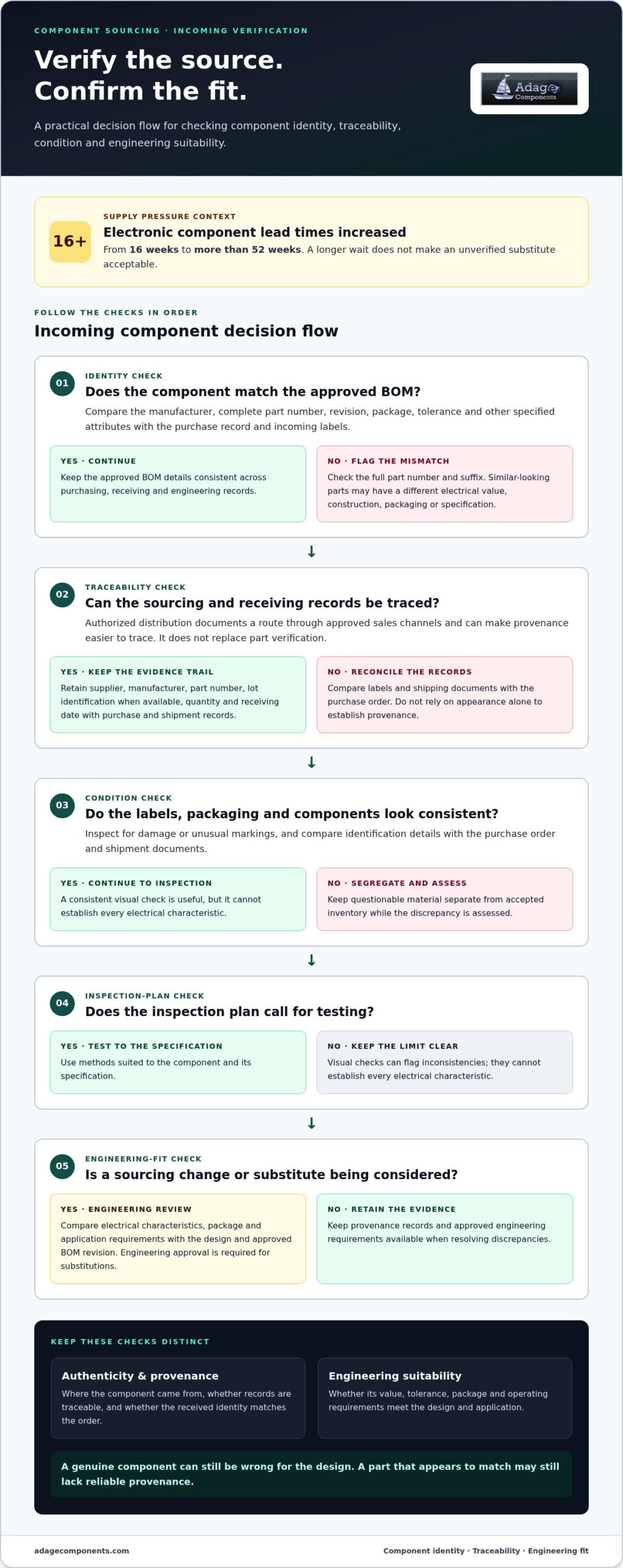
Authorized distribution describes a documented route from a component manufacturer through approved sales channels. For procurement teams, that route can make provenance easier to trace. It doesn’t replace part verification, however. The order must still match the approved manufacturer, complete part number, revision, and purchasing specification.
Start with the exact part number on the bill of materials (BOM). Compare the manufacturer, package, tolerance, and other specified attributes with the purchase record and incoming labels. A similar-looking component may have a different electrical value or construction. A suffix can also identify a packaging or specification variant. Keep these details in purchasing records so receiving and engineering teams work from the same requirements.
What safety, compatibility, and signal-loss risks should you consider? A component with the wrong rating or electrical value can fail under its application conditions, create compatibility problems, or alter circuit behavior. In a signal path, unsuitable resistance, capacitance, tolerance, or parasitic characteristics can increase attenuation or distortion.
Authenticity and suitability are related, but they aren’t interchangeable. A genuine component can still be wrong for a design if its value, tolerance, package, or operating rating doesn’t meet the specification. A part that appears to match may also lack reliable provenance. Treat traceability and engineering fit as separate checks, and compare both against the same approved BOM revision.
For incoming inspection, keep a consistent evidence trail instead of relying on appearance alone. Record the supplier, manufacturer, part number, lot identification when available, quantity, and receiving date. Compare labels and shipping documents with the purchase order. If the inspection plan calls for testing, use methods suited to the component and its specification. Visual checks can flag inconsistencies, but they can’t establish every electrical characteristic.
- Confirm identity: match manufacturer and full part number to the approved BOM.
- Review documentation: retain purchase and shipment records with receiving data.
- Check condition: inspect packaging and components for damage or unusual markings.
- Escalate discrepancies: segregate questionable material from accepted inventory while the issue is assessed.
Authorized channels can support traceability, while inspection helps catch mismatches and handling issues. Neither step should replace engineering approval for substitutions. If sourcing changes, compare the proposed component’s electrical characteristics, package, and application requirements with the design before release. That discipline helps purchasing decisions protect both production continuity and circuit performance.
Neither documented sourcing nor incoming inspection alone establishes that a component suits the circuit. Retain provenance evidence and approved engineering requirements when resolving a discrepancy. Every electronic circuit must contain at least one active component, so substitutions affecting that requirement call for particular care.
Supply constraints can put pressure on purchasing decisions. Electronic component lead times increased from 16 weeks to more than 52 weeks. A longer wait does not make an unverified substitute acceptable; evaluate alternatives against design requirements before changing purchasing records. Electronic distributor components may be housed inside the distributor or located externally, with only the pickup unit visible inside. Confirm the actual component arrangement and identity against documentation rather than treating a visible pickup unit as proof of the enclosed part.
Distributor selection by purchasing needs
For procurement, the right distributor depends on the buying task, not just the component category. A production team replenishing approved parts needs consistent ordering and delivery processes. An engineering team evaluating a substitute needs technical details and clear part identification. Map those needs before comparing commercial terms.
What are the main types of passive electronic distributors? Common channel types include manufacturer-authorized or franchised distributors, independent distributors, specialist distributors, and catalog-based suppliers. They differ in sourcing routes, product focus, ordering processes, and support for purchasing and engineering teams.
An authorized or franchised distributor sells through a manufacturer-approved channel. That route can suit buyers who prioritize direct sourcing and manufacturer-aligned documentation. Independent distributors source through broader networks and may help with hard-to-source parts or changing supply needs. Specialist distributors focus on defined component categories, while catalog suppliers support structured searches across a broad range.
These categories can overlap. A specialist can also be franchised, and a catalog supplier can serve production accounts. Compare the actual capabilities behind each label. A buyer with recurring resistor and capacitor demand, for example, may value BOM coverage, order consolidation, and reliable replenishment. A team buying a one-time prototype quantity may prioritize low-volume purchasing and access to specifications.
Quotes in the United States are typically based on the component or purchase order, with the total shaped by the exact part, quantity, packaging, sourcing channel, and delivery requirements. Compare quotes using the same manufacturer part number, revision, quantity, and shipping terms. A lower unit price can be offset by order minimums, split shipments, or added handling, so assess total landed cost rather than unit price alone.
Build a comparison around measurable purchasing needs. A short scorecard can align procurement, engineering, and production before approval:
- BOM coverage: compare the number and type of required line items a distributor can support.
- Order fit: match minimum quantities and packaging to consumption and inventory policies.
- Technical response: assess how clearly specifications, substitutions, and lifecycle changes are handled.
- System integration: review how quotes, purchase orders, and shipment records fit your MRP workflow.
- Cost structure: compare the same order configuration, including freight and other stated charges.
For a mixed BOM, electronic components BOM cost analysis can identify where sourcing changes affect overall spend. Reviewing a component line card can also help match required categories to a supplier’s product scope. Keep approved part numbers and substitution decisions aligned across engineering, purchasing, and receiving.
Global distributors and regional reach
A global supplier can connect component sourcing with purchasing teams and production sites across regions. That reach matters when a manufacturer builds in North America and sources materials for facilities in Europe or Asia. Ask whether one supplier can coordinate the required components, order records, and delivery expectations across those locations.
Regional demand can shift the wider electronics supply environment. In the period reported by the Semiconductor Industry Association, semiconductor sales increased by 43.2% in Europe, 34% in Asia Pacific, 28.3% in China, 22.9% in the Americas, and 21.2% in Japan. These figures describe semiconductor sales, not passive-component availability, but they illustrate why sourcing conditions can vary across markets.
Assess regional reach against your actual purchasing map. List the ship-to countries, receiving facilities, and component categories on a recurring BOM. Then compare how a supplier handles quote coordination, order visibility, and communication across those locations. A supplier that serves one site well may still require separate processes for another region.
- Location coverage: map each manufacturing and receiving site to the supplier’s operating footprint.
- Order coordination: compare how consolidated BOM orders and split deliveries are managed.
- Communication: identify who handles purchasing questions across time zones and business units.
- Records: align invoices, packing information, and component identifiers with each facility’s receiving process.
Regional reach also affects how teams plan inventory. A centralized purchasing group may place orders for several plants, while each facility controls its own replenishment schedule. In that case, the distributor’s processes should support both a consolidated view and location-specific requirements. For instance, purchasing may need one record for a shared BOM, while receiving teams need shipment details tied to their individual sites.
Compare the operating model using a real transaction rather than a broad claim of global service. Use a representative order with several passive-component lines and identify each line’s destination. Review how the quote, order confirmation, shipment updates, and receiving documents move through the process. This shows whether regional coordination fits your MRP workflow.
International logistics can connect supply sources with production demand, but geographic reach alone doesn’t establish fit. Compare location coverage, communication, order handling, and record keeping together. For a multi-region manufacturer, these factors help determine whether one sourcing relationship can support consistent purchasing while meeting each facility’s specific requirements.
Working with an electronics distribution partner
A sourcing relationship works best when purchasing, engineering, and production have clear responsibilities. Engineering can own component approval, purchasing can manage commercial terms, and receiving can record incoming material. A named contact for each function helps routine orders and exceptions follow the same process.
How does a passive electronic distributor compare with an active distributor? A passive-component distributor focuses on parts such as resistors and capacitors, while an active-component distributor focuses on devices such as semiconductors. Passive components don’t provide amplification or control, while active components typically need direct-current energy to perform their function.
What are the advantages and disadvantages of passive electronic distribution? A focused supplier can simplify sourcing across passive-component categories and consolidate purchasing. Its scope may not cover every active device or specialized requirement, so buyers may need separate sourcing channels for a complete BOM.
A strong working relationship starts with shared demand information. A buyer can provide an approved BOM, expected consumption, and known production changes. The supplier can use these inputs to align quotes and order planning. For example, a capacitor value revision should prompt a coordinated review, not an automatic substitution.
Set operating rules before the first production order. Define who approves alternates, how engineering changes reach purchasing, and which records accompany each shipment. A straightforward change-control process helps prevent an obsolete BOM revision from being reordered after design approval changes.
- Forecast updates: share changes in planned demand and production schedules.
- Substitution control: route proposed alternatives to engineering for documented approval.
- Order exceptions: assign an owner for shortages, partial shipments, and revised delivery dates.
- Issue records: connect receiving discrepancies to purchase orders and affected BOM lines.
A supplier can also help coordinate a response when sourcing conditions change. If a specified resistor becomes difficult to source, procurement can identify the affected assemblies and timing. Engineering can assess a proposed equivalent against circuit requirements, while purchasing considers cost and order impact. Keeping these decisions connected reduces the risk of unapproved parts entering production.
Assess the relationship through operational outcomes, not promises. Review quote accuracy, order status visibility, documentation quality, and how teams resolve discrepancies. Recurring part-number errors may point to a master-data issue, for example, while repeated shipment splits may call for revised order planning.
Passive-component sourcing is one part of a broader electronics supply chain. A partner adds value when it connects sourcing with your internal controls, from BOM changes to receiving records. Clear ownership, documented approvals, and regular demand updates turn individual transactions into a coordinated procurement process.
How does a passive electronic distributor work?
A passive electronic distributor connects component manufacturers or sourcing channels with businesses that need parts for production. It handles commercial and supply tasks for items such as resistors and capacitors. The supplier helps translate an engineering-approved BOM into purchasable line items, then coordinates quotes, orders, and delivery records.
For example, an electronics manufacturer may need a specific resistor value, tolerance, package, and manufacturer part number. Purchasing submits those requirements for a quote. The supplier checks the identifiers against its sourcing options and returns a commercial offer with order details. Engineering remains responsible for approving the specified part or any proposed substitute.
A typical transaction moves through connected stages. Each stage keeps purchasing information aligned with the design and receiving process:
- Requirements: purchasing supplies approved part numbers, quantities, and delivery destinations.
- Sourcing: the distributor identifies supply channels and prepares pricing and order terms.
- Order processing: purchasing issues an order, and the distributor coordinates fulfillment.
- Receiving: the facility compares delivered labels and documents with its purchase order and BOM.
Passive components perform functions such as limiting current, storing charge, or filtering signals. A resistor, for instance, must meet the circuit’s specified resistance and tolerance. A capacitor must meet the design’s required capacitance and other relevant electrical characteristics. Sourcing is a commercial task; the design requirements determine whether a component is suitable.
A passive electronic distributor can also support BOM coordination when a buyer sources several component types. Consolidating commercial information across resistor and capacitor lines can help purchasing compare orders in one workflow. If a line is unavailable through the initial sourcing route, engineering must review any alternate before production uses it. This separation keeps design changes under control.
Order records connect purchasing to inventory planning. A purchase order identifies the requested parts and quantities, while shipment documents help receiving reconcile what arrived. Procurement can then update its MRP records with the received quantity and approved component identity. For a multi-line order, matching each delivery to its BOM line helps teams identify shortages or discrepancies.
The practical value comes from a coordinated flow, not from changing how a component works inside a circuit. A passive electronic distributor can help purchasing map component categories against sourcing needs. Use the electronic component line card as a reference point for planning BOM discussions.
In an engine, an electronic distributor is an ignition component: it routes electricity from the ignition coil to each spark plug at the correct time. Its rotor rotates at one half the speed of the engine’s crankshaft. The rotor sits on the distributor shaft and is keyed to fit in only one position. It receives high-voltage electricity from the ignition coil through brushes at its centre, then passes close to the output contacts for each cylinder.
A common electronic distributor pickup uses a Hall effect unit to detect a rotating magnetic field. Many distributors on electronic fuel-injection engines use electronics rather than vacuum and centrifugal systems to adjust ignition timing. This automotive meaning differs from a passive electronic distributor that coordinates component sourcing, orders, and delivery: the terms describe different functions.
Adage Components: Thick Film Chip Resistors
Adage Components supports resistor sourcing with Thick Film Chip Resistors, Thin Film Precision Resistors, and Carbon Film Resistors. We offer manufacturer pricing and OEM pricing, with the same advantages as buying from tier 1 distributors but at OEM pricing. Our goal is to provide one of the best costs in the industry while helping you align component choices with your approved requirements.
Quality assurance includes partner oversight. The Diode OEM Partner holds ISO 9001, IATF 16949, ISO 14001, and QC080000 certifications; these credentials apply to that partner, not to every product category. Our international logistics program and growing state-of-the-art warehouse support sourcing coordination, short lead times, and planning that fits your MRP system. We coordinate delivery requirements with your facility’s schedule.
For resistor sourcing or BOM cost analysis, contact Adage Components to discuss your requirements.
Turn sourcing criteria into a stronger next step
A sourcing decision becomes more useful when it turns into a repeatable internal process. Before the next purchasing cycle, align procurement, engineering, and receiving around one approved BOM revision, defined substitution authority, and a shared record of order changes. That gives each team a consistent basis for reviewing availability, specifications, and delivery coordination.
Choosing a passive electronic distributor should support that discipline, not add a disconnected workflow. Adage Components supplies thick film chip resistors and other electronic components, and supports OEMs and EMS providers with sourcing and technical support. If your team is evaluating resistor sourcing or connecting component requirements with purchasing plans, begin with the relevant component categories and share your RFQ or BOM with Adage Components.
Review the resistor and component line card as you prepare your requirements. A concise BOM, target quantities, and delivery locations help make the next conversation more useful. Bring your sourcing priorities into focus, and take the next step with confidence.
Frequently Asked Questions
What does a passive component supplier do?
A passive electronic distributor sources and sells components such as resistors and capacitors for electronic circuits. These parts can limit current, store charge, or filter signals. The term describes an electronics supply channel, not an automotive ignition distributor. That separate device routes high-voltage electricity to spark plugs.
What are passive electronic distributors used for?
A supplier can help manufacturers source passive parts for new designs, production replenishment, and product maintenance. A control-board project, for example, may need resistors to set circuit values and capacitors to filter signals. A supplier can organize component requirements across a BOM, while design engineers select parts that meet the circuit’s intended function.
How should you select a distributor for an electronics project?
Start with the project’s component categories, order quantities, production schedule, and delivery locations. Then assess whether the supplier’s purchasing process fits your systems and decision flow. For a prototype moving toward production, consider whether the same passive electronic distributor can support changing quantities and revised requirements. Compare proposals against your BOM and operational priorities, not just unit price.
Disclaimer
Cross-referenced components needs to be confirmed by the client with either spec. sheet or samples or both.
Please note, we use AI to help us, information is verified to be correct but we can not guarantee 100% accuracy.