

With raw material costs for electrolytic capacitors surging by up to 40% in mid-2026, the margin for procurement error has effectively vanished. You’re likely facing a volatile market where major manufacturers have already implemented double-digit price hikes to offset rising energy and metal costs. It’s a high-stakes environment where balancing ESR requirements against tightening budget constraints feels like a zero-sum game. We understand that long lead times and the risk of unvetted components can stall your production lines and compromise your power supply designs.
This guide provides the technical and strategic framework needed to master these components while securing OEM pricing that rivals the largest global distributors. You’ll learn to navigate the trade-offs between capacitance, voltage, and size to optimize your designs for both commercial and automotive grade standards. We’ll outline how to verify part authenticity through vetted manufacturers and leverage a short leading logistics program. By the end of this briefing, you’ll have the data to integrate high-performance components into your MRP system, ensuring they arrive at your facility in real time and on time.
Key Takeaways
- Understand the internal construction of electrolytic capacitors, including how aluminum foil etching and oxide layer thickness determine energy density and voltage rating.
- Learn to balance ESR and ripple current specifications to prevent overheating and extend the operational lifespan of your power supply circuits.
- Discover how to verify component authenticity by working with vetted manufacturers franchised by top 100 distributors to mitigate supply chain risks.
- Reduce your BOM costs by securing OEM pricing and manufacturer-direct advantages that outperform traditional tier-1 distribution channels.
- Streamline your MRP system with an international logistics program designed for short leading times and real-time delivery of automotive and commercial grade parts.
What are Electrolytic Capacitors and Why are They Essential?
An electrolytic capacitor is a polarized passive component that utilizes an electrolyte to achieve significantly higher capacitance values than other capacitor types. They’re the primary choice for circuits requiring high energy density in a compact footprint. While ceramic or film capacitors offer low ESR at high frequencies, they can’t compete with the capacitance-to-volume ratio of electrolytic capacitors. For instance, while MLCCs are often limited to lower capacitance values for bulk storage, electrolytic variants easily reach thousands of microfarads. This makes them the functional backbone of modern power supply units and decoupling networks.
To better understand the internal working principles of these components, watch this technical breakdown:
The Chemical Basis: Electrolysis in Electronics
Electrolysis is the core manufacturing process. It forms a thin aluminum oxide layer on the anode foil, serving as the dielectric. This layer’s extreme thinness is what allows for high capacitance per unit volume. The liquid or gel electrolyte acts as the cathode, ensuring full contact with the etched surface of the anode. It also provides a critical self-healing property; the electrolyte can repair minor defects in the oxide layer during operation. The electrochemical mechanism relies on the unidirectional growth of the oxide layer through an applied voltage, which dictates the component’s strict polarized operation.
Primary Industrial Applications
In industrial environments, these components are indispensable for power management and signal integrity. Common applications include:
- Power Supply Filtering: They smooth the rectified output in AC-DC converters, removing voltage ripples to protect sensitive downstream electronics.
- Energy Storage: High-capacitance variants provide the burst energy required for pulse power systems and motor starters.
- Signal Processing: They facilitate audio frequency coupling and decoupling, ensuring signal integrity in industrial automation hardware.
Adage Components sources these essential parts through vetted manufacturers franchised by top 100 distributors. We ensure your facility receives authentic components that meet both commercial and automotive grade standards. By offering OEM pricing and an international logistics program, we help you manage BOM costs while maintaining short leading times for your MRP system. Our growing state-of-the-art warehouse ensures that high-quality electrolytic capacitors arrive at your facility in real time, on time.
Anatomy and Construction of Aluminum Electrolytic Capacitors
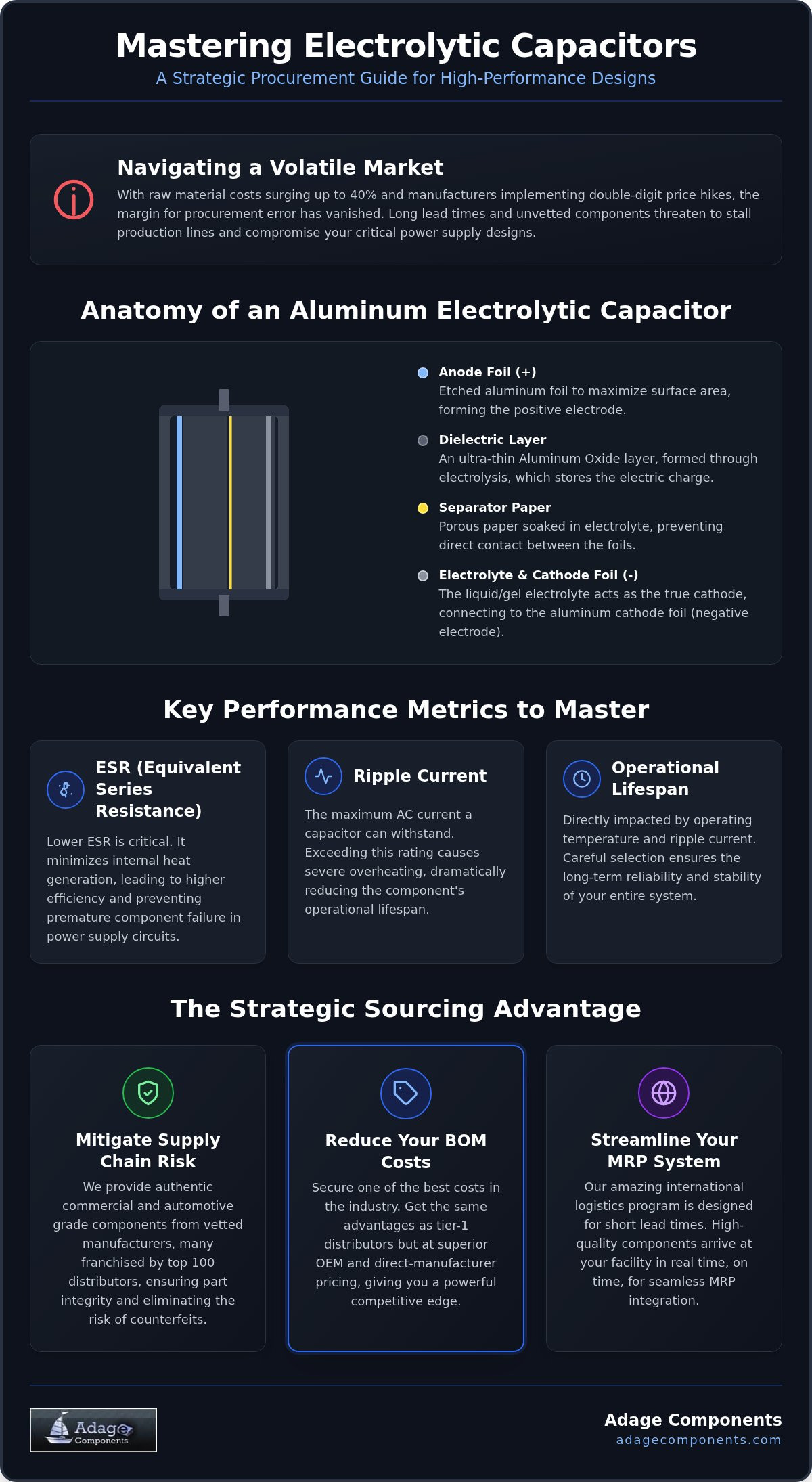
The internal architecture of electrolytic capacitors is a study in precision engineering designed to maximize energy storage within a defined volume. At its core, the component consists of two aluminum foils: the anode and the cathode. A spacer, typically made of high-purity separator paper, prevents direct contact between these foils while holding the electrolyte in place. This layered structure is rolled and placed into a housing that must maintain a perfect seal to ensure long-term reliability.
Etching is the most critical stage of foil preparation. Manufacturers use chemical or electrochemical processes to create a microscopic pit structure on the aluminum surface. This significantly increases the effective surface area, sometimes by a factor of 100 or more, which directly correlates to higher capacitance. The dielectric layer is then formed on this etched surface through anodic oxidation. Polarity is a non-negotiable factor. These units are designed for DC circuits where current flows in one direction. Reversing the polarity causes the dielectric layer to dissolve, leading to rapid gas generation and component failure.
Wet vs. Solid Electrolytes
Traditional wet electrolytic capacitors use a liquid or gel electrolyte. They offer excellent self-healing properties and remain a cost-effective solution for bulk energy storage. Modern polymer solid electrolytes are replacing them in high-reliability applications. Solid polymer versions provide significantly lower ESR and eliminate the risk of electrolyte dry-out. For automotive grade components, solid electrolytes are often preferred because they maintain stability across extreme temperature fluctuations and offer a superior operational lifecycle.
Form Factors: Radial, Axial, and V-Chip
Selecting the correct package is essential for both thermal management and assembly efficiency. Radial and axial leads are standard for through-hole applications, providing robust mechanical support in high-vibration environments. In contrast, V-Chip packages are designed for surface mount technology (SMT), facilitating high-speed automated assembly. These form factors directly impact your MRP system planning. Standardized packaging ensures that components move through your facility in real time, on time, without assembly bottlenecks.
We provide these diverse form factors through vetted manufacturers franchised by top 100 distributors that comply with all ISO certifications. Adage Components ensures you get manufacturer pricing without compromising on quality. Our growing state-of-the-art warehouse and amazing international logistic program are built to support short leading times for both commercial and automotive requirements, offering you the same advantages as buying from tier 1 distributors but at OEM pricing.
Key Performance Metrics: ESR, Ripple Current, and Lifespan
Mastering the technical specifications of electrolytic capacitors is essential for ensuring hardware reliability. Two metrics dominate the performance landscape: Equivalent Series Resistance (ESR) and ripple current. ESR represents the internal resistance that opposes current flow. This resistance leads to power loss and localized heating. Low ESR is vital. Minimizing it’s the most effective way to improve circuit efficiency and reduce the thermal load on adjacent components. Ripple current, the AC component riding on a DC signal, generates internal heat through the ESR. If ripple current exceeds the manufacturer’s rated limit, the electrolyte will overheat and eventually rupture the safety vent.
Strategic voltage derating is another critical practice for industrial designers. Operating a capacitor at 70% to 80% of its rated voltage significantly reduces the risk of dielectric breakdown. This buffer is particularly vital in industrial environments where voltage spikes are common. By selecting electrolytic capacitors with higher voltage ratings than the nominal circuit voltage, you provide a safety margin that directly translates to system longevity. It’s a simple but effective reliability strategy.
Managing Thermal Stress
Internal self-heating is the primary enemy of component longevity. When ripple current flows through the ESR, the resulting power dissipation raises the core temperature. Engineers must prioritize heat sink integration and optimized airflow around high-power components. This prevents thermal runaway. For securing these critical thermal management components, precision fasteners from franklinfastener.com ensure stability under mechanical stress. Automotive grade components are specifically engineered to withstand these fluctuations. They utilize advanced electrolyte formulations and robust sealing to maintain performance in high-heat environments like engine compartments or external power modules.
Most industrial components carry load life ratings between 2,000 and 10,000 hours at their maximum rated temperature. The operational life is governed by Arrhenius Law, which describes the chemical reaction rates within the electrolyte. A 10-degree Celsius drop in operating temperature can double a capacitor’s life. Excessive ripple current accelerates electrolyte evaporation. This leads to a loss of capacitance and an increase in ESR over time, which eventually causes circuit failure.
Adage Components provides access to ISO-certified parts from vetted manufacturers franchised by top 100 distributors. We offer manufacturer pricing that rivals tier-1 distributors, giving you a competitive edge on BOM costs. Our amazing international logistics program and state-of-the-art warehouse ensure your components arrive at your facility in real time, on time. This efficiency is perfect for your MRP system. We provide short leading times for both commercial and automotive grade components, ensuring your production never stalls. Get OEM pricing today by submitting your BOM for a professional cost analysis.
Strategic Sourcing: Navigating the Global Capacitor Market
Market volatility in 2026 has redefined how OEMs source electrolytic capacitors. With raw material costs for metals and chemicals rising between 10% and 40% as of July 2026, traditional distribution markups can cripple a project’s budget. We position ourselves as a strategic bridge, offering manufacturer pricing that rivals the advantages of tier-1 distributors. This approach provides you with one of the best costs in the industry while securing the supply chain against geopolitical tensions and energy-driven price hikes.
Risk mitigation is the cornerstone of our sourcing philosophy. We identify authentic components through a network of partner suppliers franchised by top 100 distributors. This rigorous vetting process eliminates the difficulty of verifying high-capacitance parts in a fragmented marketplace. By utilizing drop-in replacements from these trusted sources, you can maintain production continuity even when standard lead times from major manufacturers become unmanageable. Our system is designed to solve difficult sourcing puzzles with disciplined expertise.
Vetting Manufacturers and Quality Standards
Our commitment to technical reliability starts with manufacturing audits. Every partner in our network must demonstrate strict ISO compliance to ensure that both commercial and automotive grade components meet global performance benchmarks. We prioritize RoHS and REACH compliance to facilitate seamless international logistics. Working with vetted manufacturers means you don’t have to choose between cost-efficiency and supply chain integrity. It ensures that every component in your power supply design is built to a rigorous standard.
Integrating with Your MRP System
Efficiency in procurement is measured by how well a supplier integrates with your existing MRP system. Our amazing international logistic program and growing state-of-the-art warehouse are designed to support just-in-time manufacturing. We focus on short leading times to ensure products arrive at your facility in real time, on time. You can leverage our comprehensive BOM cost analysis to identify immediate savings and optimize your inventory carry costs. This level of integration reduces cognitive load on your procurement team while maximizing operational uptime.
To secure the high-standard components your project requires at OEM pricing, view our full linecard and initiate a transactional inquiry today.
Sourcing Aluminum Electrolytic Capacitors from Adage Components
Adage Components operates as a Canadian based private label manufacturer and specialist distributor. We provide a definitive solution for engineers and procurement officers struggling with the current market up-cycle. By sourcing electrolytic capacitors through our global infrastructure, you bypass the standard markups of traditional distribution. We offer one of the best costs in the industry. This ensures your power supply designs remain competitive without sacrificing technical precision or reliability.
The Adage Advantage: Tier 1 Benefits at OEM Costs
We’ve built our reputation on a model that delivers the same advantages as buying from tier 1 distributors but at manufacturer pricing. This is made possible through our distributor-affiliated program. We leverage deep partnerships with partner suppliers franchised by top 100 distributors. Every component is vetted. We conduct rigorous manufacturing audits to verify ISO compliance; this ensures that both commercial and automotive grade components meet your strict reliability standards. Our role is to act as your strategic problem solver, providing authentic components that are fully traceable and tested.
Logistics shouldn’t be a bottleneck for your production. Our amazing international logistic program is designed to integrate perfectly with your MRP system. We manage a growing state-of-the-art warehouse that supports short leading times and ensures products arrive at your facility in real time, on time. This infrastructure allows us to mitigate the risks of long lead times and volatile global supply chains. Whether you’re scaling a new power converter or maintaining a legacy system, our logistics team provides the composed confidence required in today’s high-stakes market.
Start Your Procurement Optimization
Optimizing your procurement starts with a data-driven approach. We have immediate availability of high-quality electrolytic capacitors across a wide range of specifications. We invite you to submit your BOM for a comprehensive cost-reduction analysis. Our specialists will identify opportunities to reduce your overall BOM costs through OEM pricing and drop-in replacement strategies.
For a more tailored approach, you can contact our Canadian headquarters for a custom logistics consultation. We’re ready for immediate operational engagement to secure your supply chain and provide the technical support your project demands. Reach out today to see how our manufacturer-direct model can streamline your facility’s operations and reduce your financial overhead.
Secure Your Supply Chain with Strategic Component Sourcing
Mastering the technical nuances of ESR and thermal management ensures your designs withstand industrial rigors. This technical precision is only half the battle. Integrating these insights with a disciplined procurement strategy allows you to balance performance with aggressive budget targets. We’ve demonstrated that sourcing electrolytic capacitors through vetted partner suppliers franchised by top 100 distributors provides the reliability your MRP system requires without the typical tier-1 price markups.
Adage Components acts as your strategic partner, offering ISO Certified Quality Management and a global stocking and logistics program that delivers in real time, on time. You can achieve the same advantages as buying from tier 1 distributors but at direct OEM pricing structures that are among the best in the industry. Our growing state-of-the-art warehouse is ready to support your commercial and automotive grade requirements with short leading times. Get Manufacturer Pricing on Electrolytic Capacitors and optimize your BOM today. We’re ready to help you navigate the global market with precision and integrity.
Frequently Asked Questions
What is the primary difference between aluminum and tantalum electrolytic capacitors?
Aluminum electrolytic capacitors utilize a liquid or gel electrolyte and offer significantly higher capacitance values and voltage ratings at a lower cost per microfarad. Tantalum capacitors use a solid electrolyte, providing superior stability and a smaller footprint, but they’re typically more expensive and have lower voltage limits. Aluminum variants are the standard for bulk energy storage in power supplies, whereas tantalum is prioritized for space-constrained, high-reliability signal filtering.
Why are electrolytic capacitors polarized and what happens if they are reversed?
These components are polarized because the dielectric oxide layer is formed through a unidirectional electrochemical process. Reversing the polarity causes the dielectric to dissolve and triggers a rapid chemical reaction that generates heat and gas. This internal pressure can lead to the component swelling, leaking electrolyte, or rupturing the safety vent. Always verify the cathode marking on the housing to ensure correct orientation before board assembly to prevent circuit failure.
How do I calculate the ripple current rating needed for my power supply?
You calculate the required ripple current rating by determining the RMS AC current flowing through the capacitor in your specific circuit topology. This involves analyzing the peak-to-peak current and frequency of the switching power supply. Ensure the component’s rated ripple current exceeds this calculated value at the maximum operating temperature. Exceeding this limit causes internal self-heating due to ESR, which significantly reduces the operational life of the device.
What does “shelf life” mean for an aluminum electrolytic capacitor?
Shelf life refers to the duration a capacitor can be stored without voltage application before its leakage current exceeds specified limits. Aluminum electrolytic capacitors can experience thinning of the oxide layer during long-term storage. While modern formulations have improved stability, components stored for several years may require a reforming process. This involves slowly increasing the voltage to rebuild the dielectric layer before the part is placed into full-load service at your facility.
Can I use a commercial-grade capacitor in an automotive application?
You shouldn’t use commercial-grade capacitors in automotive applications because they lack the rigorous stress testing required for vehicle environments. Automotive grade components must pass AEC-Q200 qualifications, which include higher vibration resistance and wider temperature cycling. These parts utilize robust construction to prevent mechanical failure and electrolyte evaporation under extreme conditions. We provide both grades to ensure your facility has the correct component for every specific industrial requirement.
How does Adage Components ensure the authenticity of its electrolytic capacitors?
We ensure authenticity by sourcing every component from vetted manufacturers franchised by top 100 distributors. Our multi-stage inspection process and strict ISO quality management systems eliminate the risk of counterfeit electrolytic capacitors entering your supply chain. We prioritize traceability and technical reliability, acting as an elite partner for OEMs who value data over vague marketing promises. This disciplined approach guarantees that every part arriving at your facility is genuine and fully compliant.
What are the benefits of sourcing private label components for my MRP system?
Sourcing private label components allows you to get manufacturer pricing that rivals tier-1 distributors while maintaining high quality standards. Our program is designed for seamless MRP integration, reducing the cognitive load on your procurement team. You gain the same advantages as buying from major brands but at OEM pricing. This model optimizes your BOM costs and provides a steady, meticulous partner for managing your facility’s critical inventory needs through our sophisticated global entity.
How can I reduce lead times for high-voltage electrolytic capacitors?
You can reduce lead times by leveraging our short leading logistics program and international stocking infrastructure. Our growing state-of-the-art warehouse in Canada maintains inventory for immediate operational engagement. We use an amazing international logistic program to ensure components arrive at your facility in real time, on time. By providing drop-in replacements from vetted partner suppliers, we solve difficult sourcing puzzles and prevent production delays caused by global supply chain volatility.
Disclaimer
Cross-referenced components needs to be confirmed by the client with either spec. sheet or samples or both.
Please note, we use AI to help us, information is verified to be correct but we can not guarantee 100% accuracy.